
 By JACOB KANG-BROWN and PETER WAGNER
February 11, 2026
Following the Money of Mass Incarceration 2026 | Prison Policy Initiative
“The broad system of mass incarceration costs the government and families of system-involved people at least $445 billion every year.”
Reflects astronomical economic, social, and human costs of mass incarceration.
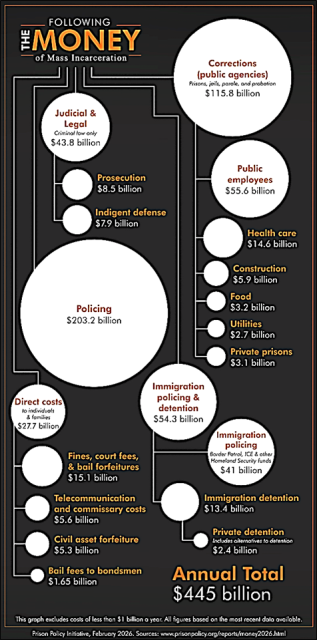 EXCERPTS: The costs of funding the police — especially the bloated budgets of militarized federal agencies in the Department of Homeland Security — have become a recurring theme in discussions about criminal legal system policy.
The expenses covered in this report do not include a full accounting of the current, ongoing economic harms of mass incarceration. For example, we do not include recent estimates of income lost when people get sent to jail or prison ($111 billion per year) or income lost by children of incarcerated parents during their working years ($215 billion per year). For that reason, our estimate — as massive as it is — should be viewed as a limited one.
At the same time, crime has declined and fewer people are incarcerated, yet spending on the criminal legal system has still increased faster than inflation. All parts of the system, from local jails to fines and fees and prison industries, deserve a clear accounting and a hard look.
 Our goal with this report is to give the “big picture” view of the economic incentives that help shape the criminal legal system, by identifying some of the key stakeholders and quantifying their “stake” in the status quo. Our data visualization shows how wide and how deep mass incarceration and criminalization have spread into the U.S. economy. We find:
- POLICING is a massive public expense and its spending has grown faster than other parts of the system in recent years. Federal expenditures related to policing and the Trump administration’s mass deportation agenda now make up 25% of all government spending on the criminal legal system. . . .
- PUBLIC SYSTEM COSTS: The criminal legal system is overwhelmingly a public system, with private prison companies acting only as extensions of the public system. The government payroll for corrections employees is over 100 times higher than the private prison industry’s profits.
- COSTS TO PRISONERS AND FAMILIES: Individuals who come into contact with the system — and their loved ones — pay over $27.7 billion a year in fines and fees, bail premiums, commissary payments, and telecommunications costs. This is over five times the amount that goes to private prisons and detention centers. Despite the fact that the Constitution requires counsel to be appointed for defendants unable to afford legal representation, the government spends only $7.9 billion on this right.
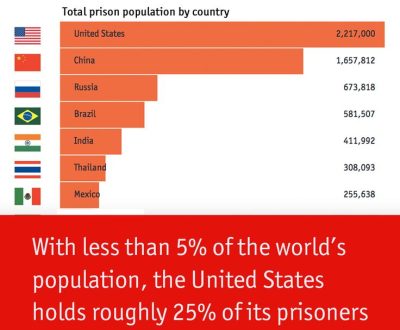
- Feeding and providing health care for nearly 2 million people, even as inadequately as they do behind bars, is expensive at $18 billion per year.
WHAT’S CHANGED SINCE 2017
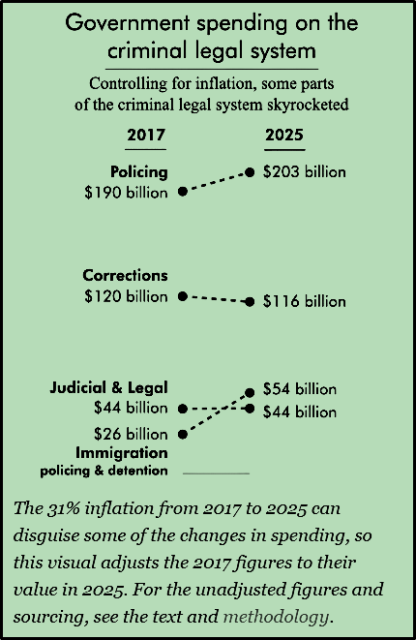
Public funding for the criminal legal system has increased in recent years, even as the number of people involved in the system has declined, reflecting changes in priorities as well as economic factors like inflation.
The largest total increase has been funding for policing, but the most rapid funding increase came in 2025 for ICE, Border Patrol and other agencies involved in the criminalization of immigration and immigration detention.
The 31% inflation from 2017 to 2025 can disguise some of the changes in spending, so this visual adjusts the 2017 figures to their value in 2025. . .
Spending on policing rose by $58.3 billion (a 40% increase) between 2017 and 2025. Expanded federal budgets account for about one-third of that increase ($19.3 billion), while state and local policing budgets grew by $38.5 billion. In contrast to the steep funding increase for police agencies, spending on public libraries grew only 22% in this same time period, from $12.7 to $15.4 billion, not even keeping pace with inflation (which was 31.5% between 2017 and 2025).
Corrections spending, a category that includes local jail, prison, probation, and parole systems, shot up $24.8 billion (a 27% increase) between 2017 and 2025, even as correctional populations shrank by over 1 million people (15%). Even as prison and jail populations have dropped, correctional payrolls continue to swell; agencies rely on overtime to meet staffing requirements and offer increasingly generous pay in vain attempts to relieve chronic understaffing.

Memorials for Renee Good, Alex Pretti in Minneapolis; ICE, CBP costs up to $54.3 Billion in 2025.
Judicial and legal expenses connected to criminal law enforcement, such as spending on prosecution and defense, grew by $10.7 billion (a 32% increase). While still under-funded compared to prosecution, increased funding for indigent defense has narrowed the gap in some states.
Finally, federal immigration- and border-related policing and immigration detention totaled $54.3 billion in 2025, up from $20 billion in 2017, making this the fastest-growing public expense in the sector. The 2025 budget, 2.7 times larger than in 2017, now makes up 13% of all government spending on the criminal legal system.
CONCLUSIONS
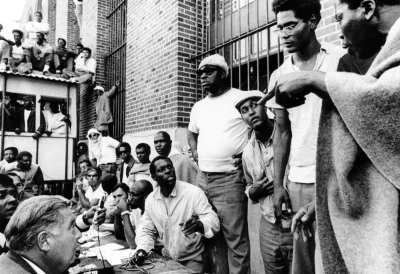
Heroes of 1971 Attica Prison Rebellion present demands for humane treatment to NY Prisons Comm. Russell Oswald. Days later, state troops slaughtered dozens of them in D Yard. Mass incarceration has risen astronomically in the decades since, touted by Democratic and Republican administrations alike.
. . . By following the money, one can see that private prison corporations aren’t the only ones who benefit from mass incarceration. By far, the public agencies and public employees are the key beneficiaries. Some of the lesser-known major players in the system of mass incarceration and criminalization include:
- Bail bond companies that collect $1.65 billion in nonrefundable fees from defendants and their families. The industry also actively works to block or rollback reforms that threaten its profits, even though reforms have been shown to reduce wealth-based pretrial detention while maintaining public safety.
- Commissary vendors and specialized telecommunications companies that sell goods, tablets, and phone calls to incarcerated people — who rely largely on money sent by loved ones — is an even larger industry that brings in $5.6 billion a year.
- Correctional health care providers that provide, at great cost, inadequate staffing, medicine, and care to people behind bars.
A graphic like this shows the relative economic cost of different parts of mass incarceration, but it can also obscure the fact that we don’t have a single monolithic “system.” Instead, we have 50 state systems, thousands of local government systems, and a federal system.
********************************************************************************


 URGENT. Funds needed for quarterly web hosting charge of $465. VOD, a pro bono newspaper, now devotes itself entirely to stories about our PRISON NATION and POLICE STATE. VOD’s editors and reporters, most of whom live on fixed incomes or are incarcerated, are not paid for their work. In addition to quarterly web hosting charge. other expenses include P.O. box fee of $226.00/yr., costs including utility and internet bills, costs for research including court records and internet fees, office supplies, gas, etc.
Please DONATE TO VOD at:
https://www.gofundme.com/donate-to-vod
***********************************************************************************



