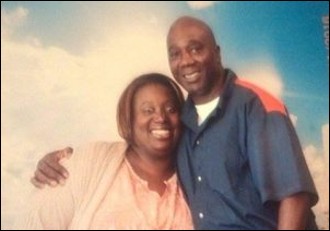
Carl Hubbard has spent over 30 years in prison for a crime he did not commit. Carl and his family have fought for decades to prove his innocence, collecting compelling new evidence, including a recantation by the prosecution’s sole “eyewitness.” The MacArthur Justice Center is urging the Michigan Parole Board to end this miscarriage of justice by granting Carl a full pardon.
From Editor Diane Bukowski: VOD is asking all justice-loving people to sign this petition. We have published multiple stories on Carl Hubbard’s case, following his battle through an unjust court system all the way to the Sixth Circuit.(VOD stories linked below).
Carl’s Story
Carl Hubbard with mother and siblings
Carl Lyndell Hubbard was born on September 19, 1964, in Helena, Arkansas. He was one of nine siblings. His mother was a sharecropper, and she largely raised Carl and his siblings on her own. She taught Carl that God would put food on the table and shoes on her feet, but in reality, his mother did that for all of them day in and day out.
She moved the family to Detroit in 1968. There, they faced poverty, discrimination, and violence. Carl was often targeted, including by local gangs. While he dreamed of playing football at Michigan State, he struggled in school because of his fear of violence in the neighborhood. He eventually dropped out of school and began working. He dreamed of buying a home and starting his own business. And he still plans to do so someday. But he has spent more than three decades in prison, since his wrongful conviction in 1992, for a crime he did not commit. In that time, several family members, including Carl’s mother, have passed away. Carl’s daughter has raised two children that Carl has never been able to meet. Now 61 years old, Carl wants nothing more than to spend the time he has remaining with those he loves.
Carl’s Case
In 1992, Carl’s life changed forever when he was framed for murder. A person named Rodnell Penn was shot and killed in the middle of the night in the neighborhood of Detroit in which Carl was living. The trail in Penn’s case soon went cold. The police found no eyewitnesses to the shooting, no blood samples or DNA evidence point to a suspect, and no murder weapon. But as has been revealed through an investigation by the U.S. Department of Justice, it was a “lawless time for Detroit’s homicide division.” Detectives regularly coerced false confessions in order to close cases.
One notorious detective named Joann Kinney—the lead investigator in Penn’s case—was no different. In a different case, Kinney had admitted to having someone “locked up as a witness for days without charges” and “threatening to take [the person’s] children away if she did not cooperate.” In another case, Kinney charged someone with murder “without a ‘scintilla of evidence.’”
To close Penn’s case, Kinney followed her familiar practice. Almost a week after the shooting, Kinney came across a nineteen-year-old named Curtis Collins walking in the area. At the time, Collins was in violation of his parole. The police ultimately took Collins into custody and pressured him to pin the crime on Carl. They threatened to “give [him] the max” for his parole violation if he did not cooperate.
Carl Hubbard, sister Evelyn
Collins yielded and became Kinney’s star witness. He claimed that he was at a party store that night near the scene of the crime, and when he heard gunshots, he turned around and saw someone running away. Despite the lack of any streetlights and being about three hundred and seventy-five feet away—more than the length of a football field—Collins claimed he spotted a small scar on the back of the person’s head. Collins claimed that he did not see the person’s face, but said the scar identified the person as Carl. Collins’ claimed identification was impossible, and it did not make much sense. The prosecution’s own expert witness could not recreate it when he tried to observe the scene from the party store, even in the clear light of day.
On the first day of trial, Collins recanted. He revealed that he had not seen Carl that night, and Collins had not even been in the area. He explained that the homicide detectives had tried to coerce him to testify falsely.
But when Collins left the stand, he was arrested and threatened with prosecution for perjury and for Penn’s murder. Collins buckled again, and on the last day of trial, he returned to the stand, claiming he did, in fact, see someone fleeing the scene and identified the scar. Citing Collins’ testimony, the court convicted Carl and sentenced him to life in prison.
However, Collins came forward on Carl’s behalf in 2019 to confirm his recantation. The interview below and one taken by a forensic examiner fully exonerated Carl.
In the decades since his conviction in 1992, Carl has worked tirelessly to collect new evidence proving his innocence. He has done so in spite of the Wayne County Prosecutor’s Office, which illegally destroyed the case files from Carl’s prosecution and countless others. Among other things, he has found:
The owners of the party store near the shooting—whom the police never interviewed—who swore that neither Collins nor Carl was in their store that night, disproving Collins’s identification story.
A sworn recantation from Collins, admitting that he lied on the last day of Carl’s trial. Collins not only signed a sworn affidavit in 2017, in which he offered to testify, but also passed a polygraph examination in 2018.
Multiple witnesses who heard Collins admit at the time of the prosecution that the police were coercing him to testify falsely.
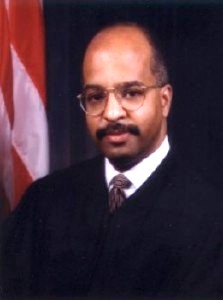
U.S. Sixth Circuit Judge Ransey Guy Cole, Jr.
Reviewing this evidence in 2024, when Carl sought federal habeas relief, Judge R. Guy Cole, Jr. of the U.S. Court of Appeals for the Sixth Circuit wrote: “[A]ny reasonable juror would doubt a conviction based on such a shaky foundation that all has since collapsed: where the new evidence impeaches the key parts of the old evidence, the State’s key witness has been discredited, and an unquestioned suspect is at play. Such doubt demands relief.”
But in a split panel decision, the Sixth Circuit held that Carl’s federal habeas petition was untimely under the strict rules of the Antiterrorism and Effective Death Penalty Act (AEDPA), and the majority rejected his request for equitable tolling based on his showing of actual innocence. Judge Cole would have granted tolling because Carl demonstrated actual innocence.
ACT NOW TO HELP FREE CARL HUBBARD
The MacArthur Justice Center, alongside co-counsel Paige Tenkhoff at King and Spalding and Alexander Kazam, represent Mr. Hubbard in pursuing a clemency application to the Michigan Parole Board.
The Michigan Parole Board has the power to recommend Carl Hubbard for a full pardon. We filed a clemency petition on July 7, 2026.
Carl is supported in these efforts by many friends and family. For example:
Carl and his sister, Evelyn
His daughter LaTorria writes: “[M]y sincerest request is that my father be granted clemency. He has remained loving and devoted to his entire family even behind bars . . . . I need him. His grandchildren need him. His entirely family need him.”
His sister Tamara writes: “As the youngest child, I have witnessed how the suffering is compounded by overwhelming loneliness and grief, especially for my oldest living brother who has always been a pillar in our family. . . . I respectfully implore you to grant clemency to my brother. Your compassion can make a crucial difference—not only by correcting a miscarriage of justice but also giving him a chance to receive the care and dignity he deserves.”
Kenneth Nixon
Kenneth Nixon, an exoneree from a wrongful conviction and co-founder of the Organization of Exonerees, writes: “I hope you will have the courage to acknowledge the wrong that’s been done here and the humanity still waiting to be restored. Carl Hubbard is not a lost cause. He is a man worth saving. We are ready for him. Please help us bring him home.”
In Carl’s own words: “I have had a hard life, but I am a good person, and I want to make something of my life. I hope you will give me this chance. I have already served decades in prison for a crime I did not commit. Please let me get back to my family and begin picking up the
UPDATE: VOD Editor Diane Bukowski attended the memorial for Essie Mae Henderson. It was awe-inspiring. The chapel was filled with her descendants of all ages, including young people who had been politically educated by Essie, and spoke of her with deep love and respect, calling her GranGran. Her daughter and granddaughter spoke with great passion about her life. The memorial concluded with the entire audience raising their fists and chanting “POWER.” Above is the detailed story of her inspiring life in the obituary._______________________________________________________ Essie Mae Henderson lived heroic life:
DETROIT BLACK PANTHER PARTY
PARALEGAL FIGHTER V. INJUSTICE @ WOMEN’S HURON VALLEY PRISON
FOUNDING MEMBER DETROIT PEOPLES’ CRIME LAB TASK FORCE
HAD DEEP LOVE FOR HER PEOPLE: GRANDSON JOHNNY HENDERSON & VICTIMS OF MASS INCARCERATION
Detroit– I was working with Essie Mae Henderson just before her passing, to help free her grandson Johnny Henderson from an unjust life term in the Michigan Department of Corrections. We were arranging to meet so we could go over his paperwork, and work with VOD’s paralegal to draft a motion for a new trial, as well as on a story in Voice of Detroit.
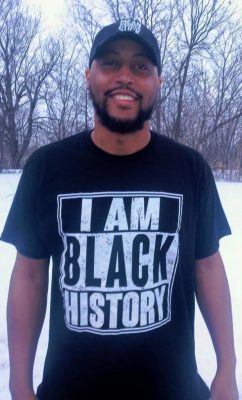
Johnny Henderson
But before we could, Johnny’s sister Yvette Henderson called to tell me that Ms. Henderson had just passed July 13, 2026. I promised Yvette we would continue Essie’s work for Johnny. During our conversations, Yvette told me there were condolences coming in from across the world. She talked about Essie’s deep love for her people, and the work she was doing ever since she came home from her own prison term on behalf of many other victims of mass incarceration.
I spoke with Marilyn Jordan, co-chair of the Detroit People’s Crime Lab Task Force, who told me more about Essie’s history with the Black Panther Party, her incarceration and other information about her struggles for her own freedom and that of her people still held in the bowels of the criminal injustice system.
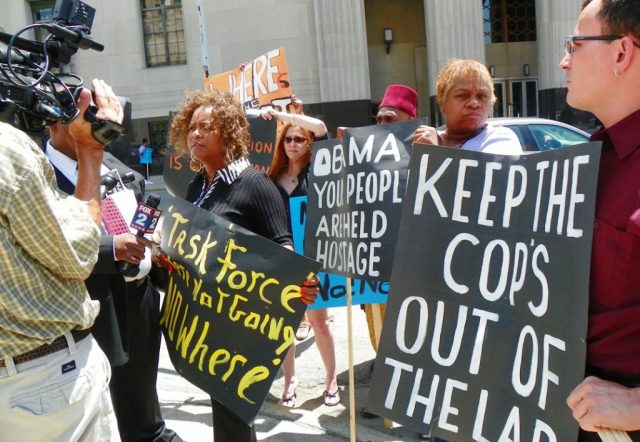
Detroit People’s Crime Lab Task Force Rally at Federal Building June 28. 2011, coordinators Marilyn Jordan (l), Roberto Guzman (r)
She told me Essie worked with the Crime Lab Task Force’s paralegal Robert Guzman on cases of those still in prison despite the shutdown of the Detroit Crime Lab in 2008 due to a review that showed rampant errors by police officers and others working there. Founding members of the Task Force from inside the walls were Johnny Henderson, Kelly Nobles, Darryl Dulin-Bey, Michael Harris, and Larry Porter.
Essie herself told me about her experiences in Women’s Huron Valley prison, serving a sentence of 25-50 years. She said she and others at the prison fought rampant injustices there. She said this was when she became a certified paralegal to assist the women.
URGENT. Funds needed for quarterly web hosting charge of $465 due Sept. 19, 2026. VOD, a pro bono newspaper, now devotes itself entirely to stories about our PRISON NATION and POLICE STATE. If fee is not paid, VOD and 14 years of stories will disappear from the web.
VOD’s editors and reporters, most of whom live on fixed incomes or are incarcerated, are not paid for their work. In addition to quarterly web hosting charge. other expenses include P.O. box fee of $226.00/yr., costs including utility and internet bills, costs for research including court records and internet fees, office supplies, gas, etc.
Attorney Shiraz Khan of the Shiraz Law Firm, representing Women’s Huron Valley inmate Krystal Clark, speaks at a press conference alongside Clark’s mother (seated to his right) and Clark’s son (seated to his left). | Sarah Ameen/Shiraz Law Firm
COURT ORDERED KRYSTAL CLARK’S TRANSFER FROM WOMEN’S HURON VALLEY TO DUANE WATERS CF, BUT ADVOCATES STILL FIGHTING TO:
Immediately transfer Clark to an outside hospital for comprehensive evaluation and treatment.
Ensure she receives care from independent medical specialists.
Release all relevant information regarding her current medical condition and treatment.
Consider immediate medical release or other available legal remedies that would aallow her to receive lifesaving medical care outside the prison system.
By Jay Love Spokesperson, Krystal Clark Freedom Team Turning A Moment Into A Movement
DETROIT, Mich. (July 14, 2026) — Advocates for incarcerated Michigan woman Krystal Denise Clark are calling for her immediate hospitalization and medical release, saying her health has deteriorated to a critical level while she remains in the custody of the Michigan Department of Corrections (MDOC).
Clark, who has been incarcerated since 2011 and maintains her innocence, was recently transferred from Women’s Huron Valley Correctional Facility to the Duane Waters Health Center infirmary following months of documented medical concerns. Advocates stress that she has not been transferred to a hospital and remains in a correctional infirmary despite what they describe as a worsening medical crisis.
According to Clark and her advocates, she is currently unable to keep food down, has gone eight days without a bowel movement, is experiencing severe abdominal swelling, continues to suffer from a documented fungal infection, and is dealing with ongoing heart-related complications. She has also reported not receiving appropriate feminine hygiene products while housed in the infirmary.
Clark’s medical history reflects a prolonged and escalating health crisis. Over the past year, she has been evaluated by multiple outside specialists and diagnosed with Aspergillus niger, a fungal infection identified in both her ears and respiratory cultures; Alternaria, a documented mold allergy confirmed through specific IgE testing; and serious bacterial infections including Klebsiella intermedia and Serratia marcescens. Medical records have also documented hemoptysis (coughing up blood), chronic respiratory illness, persistent headaches, facial swelling, a left-sided facial droop, severe skin rashes, debilitating fatigue, visual disturbances, and progressive weakness.
Outside infectious disease specialists have repeatedly warned that Clark cannot recover while remaining in a mold-contaminated environment. One specialist recommended six to twelve months of advanced antifungal therapy with close laboratory monitoring and stated that she should be permanently removed from mold exposure. Other treating physicians documented concern that the fungal infection could become invasive, while occupational medicine specialists confirmed her significant allergy to mold and advised that she should avoid any future mold exposure.
Despite these documented medical findings and recommendations, advocates say Clark has continued to experience prolonged exposure to environmental conditions that have exacerbated her illness. They argue that her transfer to another correctional facility, rather than to an acute-care hospital, fails to address the severity of her medical condition and places her at continued risk of irreversible harm.
Jay Love speaks at press conference for Krystal Clark.
“Krystal has repeatedly told us that she feels like she is dying,” said Jay Love, spokesperson for the Krystal Clark Freedom Team. “She was not sentenced to death. She deserves access to timely, appropriate medical care, just as any person would.”
An emergency legal motion seeking relief for Clark was recently filed in federal court. While the court ordered her transfer from Women’s Huron Valley Correctional Facility, advocates say the transfer alone has not addressed her urgent medical needs.
Clark’s case has drawn increasing attention from lawmakers, medical professionals, faith leaders, formerly incarcerated advocates, and human rights organizations amid broader concerns about reported medical neglect and environmental conditions within Michigan’s prison system.
Advocates are calling on Governor Gretchen Whitmer, MDOC leadership, and state officials to:
Immediately transfer Clark to an outside hospital for comprehensive evaluation and treatment.
Ensure she receives care from independent medical specialists.
Release all relevant information regarding her current medical condition and treatment.
Consider immediate medical release or other available legal remedies that would aallow her to receive lifesaving medical care outside the prison system.
“Every day matters,” Love said. “If Michigan truly values human life, now is the time to act. We cannot wait until another family is forced to mourn someone who should have been saved.”
URGENT. Funds needed for quarterly web hosting charge of $479 due Sept. 19, 2026. VOD, a pro bono newspaper, now devotes itself entirely to stories about our PRISON NATION and POLICE STATE. If fee is not paid, VOD and 15 years of stories will disappear from the web.
VOD’s editors and reporters, most of whom live on fixed incomes or are incarcerated, are not paid for their work. In addition to quarterly web hosting charge. other expenses include P.O. box fee of $226.00/yr., costs including utility and internet bills, costs for research including court records and internet fees, office supplies, gas, etc.
“CASE SHOWS A PATTERN OF SYSTEMIC DPD CORRUPTION” — ATTY. PHILLIP COMORSKI
WITNESS SWEARS NOTORIOUS DPD COP BARBARA SIMON, CITED IN MULTIPLE WRONGFUL CONVICTIONS, FALSIFIED STATEMENT, FORGED SIGNATURES
SYKES WAS SHOT BY DPD COPS 15 TIMES IN 1998, WON A CIVIL LAWSUIT AGAINST THEM; BELIEVES THIS LED TO HIS 2001 FRAME-UP
YOST AND DPD’S EUGENE BROWN KILLED LAMAR GRABLE IN 1996, ANOTHER CASE OF MISTAKEN IDENTITY
GRABLE’S FAMILY WON $6 MILLION CIVIL JURY VERDICT AGAINST BROWN; COA CITED LIKELY ‘DEVIANT POLICE BEHAVIOR’ BY BROWN AND YOST TO COVER-UP THE MURDER OF LAMAR GRABLE
YOST NOW WORKS AS PRIVATE INVESTIGATOR FOR WCPO, CIU, etc., APPEARS UNTOUCHABLE FOR CRIMES COMMITTED AS DPD OFFICER
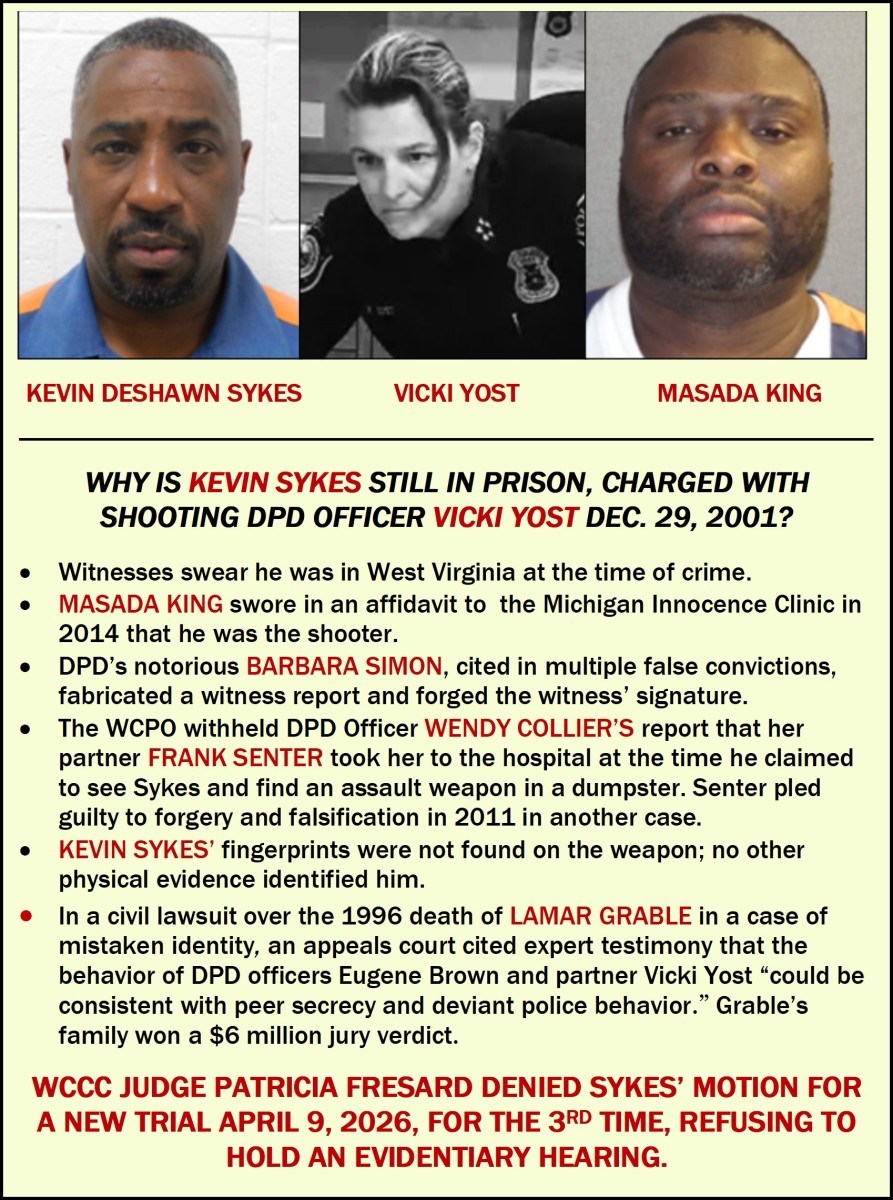
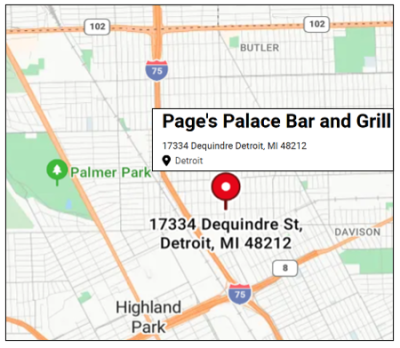
DETROIT--Kevin Sykes is serving concurrent terms of 39 to 70 years for “assault with attempt to commit murder” on charges of shooting former DPD Lt. Vicki Yost in the leg and shooting at her partner, outside Page’s Palace Bar and Grill on Detroit’s east side, on Dec. 29, 2001. His earliest release date is 1/24/2043, with a maximum date of 1/24/2074.
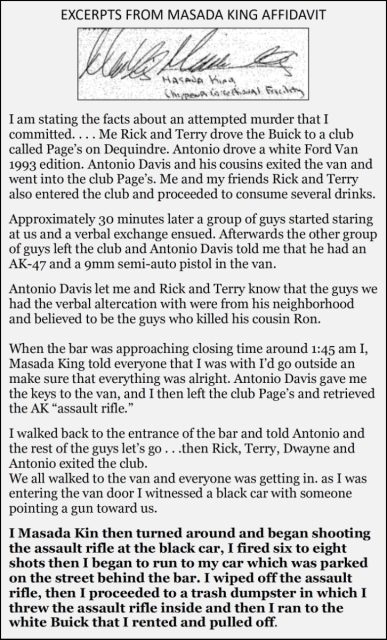
Sykes has sworn since he was charged that he is innocent, that he was not even in Michigan at time of the crime. The University of Michigan’s Innocence Clinic has strongly supported him. They obtained a sworn, detailed affidavit confessing to the crime from another man, Masada King.
But they recently cited a conflict of interest in pursuing the Sykes case, because the victim was DPD Lt. Vicki Yost, now a private investigator, who was working on another case they were handling. Yost’s questionable history with the Detroit and Inkster Police Departments is addressed later in this story.
Atty. Phillip Comorski
Sykes is now represented by defense attorney Phillip Comorski, who filed a MOTION FOR NEW TRIAL UNDER MCL 770.1, OR IN THE ALTERNATIVE SUCCESSIVE MOTION RELIEF FROM JUDGMENT UNDER MCR 6.502(G)(2).
WCCC Judge Patricia Fresard, Sykes’ trial judge in 2002, denied Sykes’ motion for a new trial and an evidentiary hearing April 7, 2026, as she did in 2004 and 2016, when the Michigan Innocence Clinic produced the real shooter, Masada King. Allegedly she said King did not identify what he was wearing.
WCCC Judge Patricia Fresard, Sykes’ trial judge in 2002, once again denied Sykes’ motion for a new trial and an evidentiary hearing April 7, 2026, refusing to hear directly from witnesses.
Judge Fresard saw Masada King’s affidavit in 2016, but declared it was not credible, in violation of People v. Johnson, 502 Mich. 541, 918 N.W.2d 676 (Mich. 2018), which says a judge cannot act in the place of a jury in determining credibility.
“[I]f a witness is not patently incredible, a trial court’s credibility determination must bear in mind what a reasonable juror might make of the testimony, and not what the trial court itself might decide[.]” Johnson, 2018.
MULTIPLE WITNESSES CONFIRM MASADA KING’S ACCOUNT OF EVENT, KEVIN SYKES’ PRESENCE IN CLARKSBURG, W. VIRGINIA DEC. 29, 2001
Fresard has now denied Sykes an evidentiary hearing in which she would have heard Masada King, the actual shooter, testify to assess his credibility, acting as a “reasonable juror,”
She would also have heard from other witnesses not examined previously, who backed up King’s confession, or confirmed Sykes’ alibi that he was in Clarksburg, W. Virginia. They include:
Felicia Dyer (box r.)
Michael Reed: “Michael Reed indicated in his affidavit that he saw King in the bar arguing with some people in what appeared to be an intense conversation. As King proceeded to leave the bar, Mr. Reed heard multiple gunshots coming from the outside.” (Defense brief.) Complete Felicia Dyer affidavit at http://voiceofdetroit.net/wp-content/uploads/Felicia-Dyer-affidavit-Kevin-Sykes-2.pdf
Richard Davis: “In his affidavit, Richard (Rick) Davis maintains that he accompanied King at Page’s Palace Bar on the night in question. At some point after their arrival, King said he had to go back out to the car, so Davis and another friend proceeded to the bar to get some drinks. Minutes after King walked out the door, Davis said he heard gunshots. . . Subsequently, Davis and others that apparently attended the bar were arrested and transported to the homicide section at 1300 Beaubien. According to Davis, the detectives referred to him as a suspect.” (Defense brief.)
Tyrone DeShawn Moore said that DPD Inv. Barbara Simon falsified his statement and forged his signature (see box left).
Lashawn Vines:
“In her affidavit, Lashawn Vines asserts that she and Mr. Sykes were in a relationship and lived together with her three children in West Virginia in 2001. Vines’ birthdate is December 22, 1976. Vines and Mr. Sykes spent her birthday together in W. Va. on December 22, 2001, and he was in W. Va. up until the time he got arrested in early 2002.”
Vines didn’t testify on Mr. Sykes’ behalf about his whereabouts because Child Protective Services threatened to take her children away from her if she continued to encounter Mr. Sykes or the criminal proceedings.” Defense brief. (VOD: Detroit police repeatedly use this tactic in other cases. THEY call CPS.)
TRIAL TESTIMONY OF DPD’S LT. VICKI YOST, OFFICER FRANK SENTER
“Lt. Vicki Yost was assigned as the shift boss for midnights at the 11th Precinct (T, Vol II, p33-34). At 1:45 a.m. there was a radio dispatch about a man with a gun at the bar (T, Vol II, p 35). Yost was in plain clothes in a semi-marked vehicle, and as she approached the bar, she saw Officers Collier and Senter exit their vehicle with their weapons drawn (T, Vol II, p 36).
SITE OF SHOOTING OF VICKI YOST 12/ 29/01
This trial testimony, cited in Sykes’ defense brief, lends credence to Masada King’s account of the shooting outside Page’s Palace, and those of the other supporting witnesses.
King describes a dispute inside the club, with members of a local gang suspected in the murder of Ron Davis, a friend of King’s and a cousin of Antonio Davis, who was originally Sykes’ co-defendant. It was dark (1:45 a.m.), Yost was in plainclothes, and her car was only “semi-marked.” King says he started shooting because someone drove up in a black car and brandished a gun at his group.
(Note: The van cited by King was registered to Davis, who was arrested. In a plea bargain before Judge Fresard, Davis pled nolo contendere t0 a charge of Weapons-Firearm-Possession by a Felon. A second charge of Weapons Carrying Concealed, was dismissed after Judge Patricia Fresard severed Davis’ case from Sykes May 1o, 2oo2, tben held an evidentiary hearing the same day for Davis. She sentenced Davis, who put the weapon involved into a van registered to him, to probation.)
EYEWITNESS ID’S BY DPD LT. VICKI YOST, OFFICER FRANK SENTER
Sykes’ attorney Comorski notes that no physical evidence ties Sykes to the shootings Dec. 29, 2001. His fingerprints were not on the assault rifle police took from a dumpster near Page’s Palace.
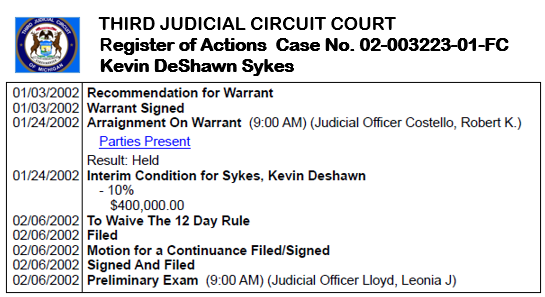
The only evidence was eyewitness ID’s by DPD Lt. Vicki Yost and DPD officer Frank Senter from a severely flawed photo line-up. Sykes was not present for a live line-up because he was in Clarksburg, W. Virginia from at least Dec. 22, 2001 to the day Detroit police came to arrest him pursuant to a warrant dated Jan. 3, 2002, on which he was not arraigned until Jan 24, 2002.
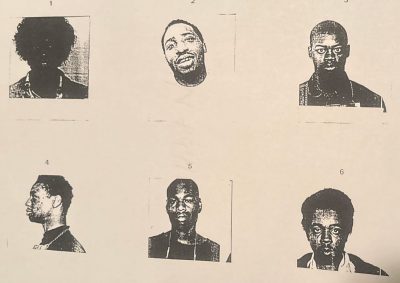
Photo line-up: Yost ID’d Sykes “I think it’s No.2, the shooter that shot at me.” Senter ID’d Sykes after Senter wrote in a police report Dec. 29 “writer did not observe the source of the shots.”
Photo line-up Dec. 31, 2oo1. All those in line-up have chains with jail ID’s around neck except Sykes #2 (top center), a tactic police use to show guilt by association, according to VOD’s legal expert. Vicki Yost: “I THINK IT’S NO. 2 (top), the shooter that shot at me.” DPD Ofc. Frank Senter ID’d #2 although he said in Dec. 29 PCR: “WRITER DID NOT VISUALLY OBSERVE THE SOURCE OF THE SHOTS.” Yost’s partner P.O. Melonie Taylor ID’d No. 5 (bottom center).
At a photo lineup two days after the incident, Yost identified Mr. Sykes saying, “I think it’s no. 2” (T, Vol II, pp 61-63, 78-79). Yost wrote no police report (T, Vol II, p 64). On December 31st, Yost also made an identification, stating “I think it’s 2, the shooter, that shot at me” (T, Vol II, p 94). At the time of the shooting, there were at least thirty to forty people outside (T, Vol II, p 82).
On December 30, 2001, Officer Senter made an “immediate identification” of Mr. Sykes, within two minutes (T, Vol II, p 92). The only photograph in the array where the person was not wearing a chain with jail ID around his neck was Mr. Sykes, making his photo stand out. Sykes told VOD that police used a photo from Jackson, Michigan taken during his arrest for playing loud music in his driveway. He was charged with DUI although he was not driving.
BOTH VICKI YOST AND FRANK SENTER ARE WHITE. THEY IDENTIFIED SYKES IN A PHOTO LINE-UP. CROSS-RACE ID’S HAVE BEEN PROVEN TO BE UNRELIABLE SOURCES OF WRONGFUL CONVICTIONS.
But in his police report Dec. 29, 2001, Senter wrote, “Info wrt made loc and observed 11-60 in f/o said loc. Wrt exited veh and began to carefully approach when several shots were heard fired. Wrt did not visually observe the source of the shots. 11-60 [Yost] did sustain an apparent gunshot wound to her lower right leg.”
On Dec. 30, 2001, Senter signed a lengthy Q & A “witness statement.” In it, he told an unknown interviewer, “Wrt then looked toward Paige’s Palace Bar when wrt observed a BM app. 5’10” to 6’0 with a stocky build walking rapidly toward a van . . . The subject had on dark pants and a tan coat w/fur around the collar. Subj then looked back in the direction of wrt and wrt observed what appeared to be a long rifle on the subj right side. . .within min radio announced subj was in the area of Modern [sp?] and Arlington. Wrt then went back to vehicle and headed S/B Dequindre toward Modern [sp?]. Upon crossing over McNichols wrt observed said subj hiding behind the driver’s side door of a 4Dr white sedan in the parking lot of the BP Gas Station on the SE corner of McNichols and Dequindre.” He said he lost sight of the subject and went back to the scene to attend to Yost until an ambulance came, then resumed looking for the subject with no further observation.
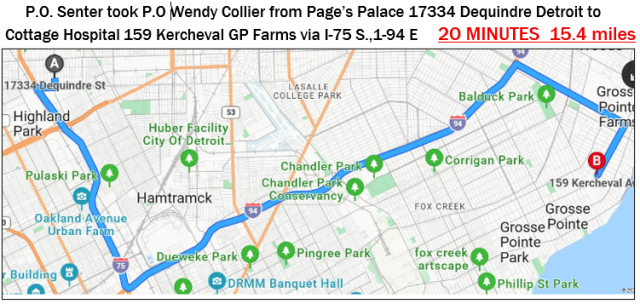
But after an FOIA was later submitted for the case file, a Dec. 29 police report fromSenter’s partner Wendy Collier that had not been provided in discovery surfaced. It said “Wrtr exited vehicle and observed a possible perp wearing a beige winter coat, in f/o loc. Seconds later, wrtr heard shots fired. Wrtr then took cover as doing so fell and landed on right hand fracturing the fourth finger. Then poss, perp. then fled in unk dir. Wrtr notified 11-70 at scene about injury. Wrtr’s partner then took wrtr to (redacted) hospital see injury report.” Other documents, however. disclosed that the hospital was Cottage Hospital in Grosse Pte. Farms, 15 miles and a 40-minute round trip from Page’s Palace.
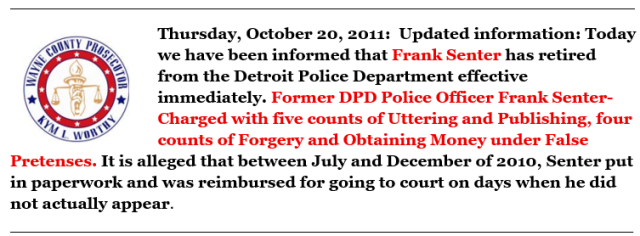
On Oct. 20, 2011, the Wayne County Prosecutor charged Senter with 5 counts of Uttering and Publishing, 4 counts of forgery and obtaining money under false pretenses.
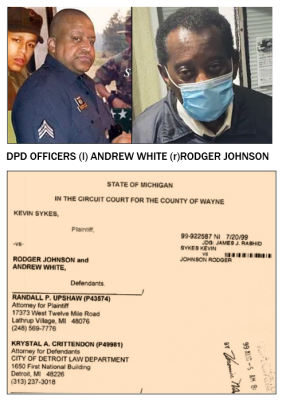
WERE CHARGES IN RETALIATION FOR SYKES’ WINNING LAWSUIT VS. DPD’S ANDREW WHITE, RODGER JOHNSON, WHO SHOT HIM 15 TIMES?
On July 30, 1998, Kevin Sykes was shot 15 times by DPD narcotics cops Rodger Johnson and Andrew White, according to a civil lawsuit filed on his behalf by Atty. Randall Upshaw, who went on to represent him at his 2002 trial.
The officers raided a home at 13461 Fleming that he was in. Sykes tried to flee next door to 13445 Fleming, jumping from a 2nd-floor bedroom window to a 2nd-floor bedroom window next door. He was stopped by window bars there.
An officer yelled ‘gun’ although he was unarmed, and White and Johnson shot him a total of 15 times, including twice after he fell from the roof to the driveway. Johnson and White were never disciplined or charged for their horrific behavior.
Atty. Randall Upshaw
The cops allegedly found a potato chip bag with some marijuana in it, near the driveway where he fell, and allegedly found a .22 caliber gun inside the bedroom he tried to break into. The lawsuit says Sykes was “severely and permanently injured. . .with multiple permanent injuries including but not limited to 15 bullet wounds causing a broken arm and multiple internal injuries.”
Sykes won his civil lawsuit for an undisclosed settlement amount. Court records show that Sykes was criminally charged, but Judge Diane Hathaway dismissed charges of Controlled Substance (delivery/manufacture (narcotic or Cocaine) Less Than 50 Gr. and Weapons Felony Firearm against Sykes. He pled Nolo Contendere to assault with a dangerous weapon, with an amended sentence of 120 days in the Wayne County Jail.
YOST INVOLVED IN 1996 LAMAR GRABLE DEATH, ANOTHER CASE OF MISTAKEN IDENTITY; MCOA FOUND HER TESTIMONY NOT CREDIBLE
After retiring from decades in the Detroit and Inkster Police Departments, Vicki Yost founded Shield Strategic Solutions, a private investigation agency.
It is now widely used by the Wayne County Conviction Integrity Unit in the Prosecutor’s office and other law enforcement agencies, as well as well as defendants whose families hire her to investigate their cases. Many extol her skills. But previously, Yost had a long and questionable career in the Detroit and Inkster Police Departments.
Newly hired after moving into Detroit, Yost was the partner of three-time killer cop Eugene Brown when he shot 20-year-old Lamar Grable to death on Sept.21, 1996 in another case of mistaken identification. That case was publicized nationally and globally.
Arnetta Grable and Herman Vallery, Lamar’s parents, helped found the Detroit Coalition Against Police Brutality and led a broad campaign for their murdered son, coalescing with the families of Brown’s other victims, Rodrick Carrington and Darren Miller. Arnetta Grable filed a civil suit against Brown, which resulted in a $4 million jury verdict, which later became $6 million after the City of Detroit’s unsuccessful appeals.
Lamar Grable’s mother Arnetta Grable (ctr.) brother Aaron Grable and sister Arnetta Grable Jr. (upper left), attys. and supporters including Cornell Squires gather after jury verdict against Eugene Brown.
Affirming the jury verdict, an appeals court said, “Dr. Peters testified to inconsistencies between Yost’s testimony regarding the manner in which the gun found near Grable’s body was fired.” (Yost admitted she took the gun home before turning it into the evidence unit.)
“Dr. Peters opined that these inconsistencies raised ‘a serious doubt’ regarding the number of shots fired or what happened to the weapon as it was being examined. Dr. Peters found it odd that Yost’s version of the events seemed to become clearer as time passed since one’s memory is generally fresher closer to the event. Dr. Peters opined that defendant’s and Yost’s behavior could be consistent with peer secrecy and deviant police behavior.”
Experts at the Eugene Brown hearing also found that Brown himself fired two shots into his own bullet-proof vest, attempting to prove that Grable had fired at him. Yost was there when Brown did this.
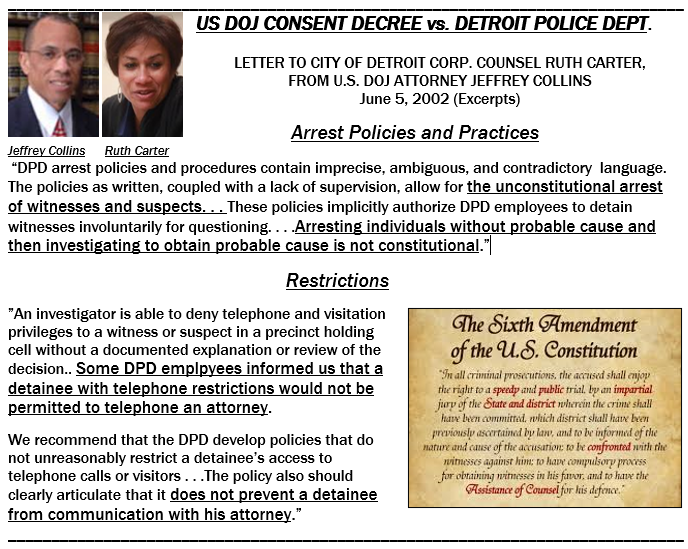
The Detroit Police Department rewarded Vicki Yost with promotion after promotion after Grable’s death. Only five years afterwards, when she was shot, Yost had made lieutenant and rapidly ascended the ranks to become a Deputy Police Chief.
Vicki Yost as Detroit Police Inspector.
Ironically, the DPD made Vicki Yost its liaison to the U.S Justice Department in 2003, as it began its investigation into DPD patterns and practices of brutality, including killings, conditions at police lockups, and illegal police dragnets, (arrests of witnesses and others to coerce their cooperation in homicide investigations).
INKSTER POLICE DEPT. HIRES VICKI YOST AS POLICE CHIEF IN 2014, NINE MONTHS BEFORE NEAR FATAL BEATING OF FLOYD DENT
The Detroit suburb of Inkster hired Yost as the city’s Chief 0f Police after she retired from the Detroit Police Department. Nine months later, in 2015, she was forced to leave under a cloud after notorious DPD cop William Melendez, nickname “Robocop,” also a new Inkster cop, became known world-wide for nearly beating Black motorist Floyd Dent to death in 2015.
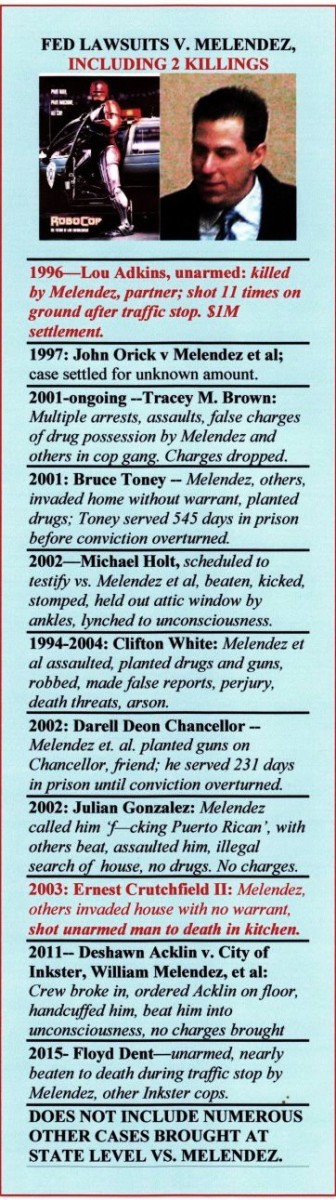
From her years in the Detroit Police Department ascending to Deputy Chief, Yost would have known that Melendez and 17 other 3rd and 4th Precinct cops were charged by the U.S. Department of Justice in 2004 with running a “Ramparts” style squad that was wreaking havoc in Detroit’s Black community, framing up defendants they arrested and torturing and beating them, including hanging them out windows and other atrocities.
A jury of largely non-Detroiters rendered a “nullification verdict” after a defense attorney for the cops warned that the victims who testified against the cops could be moving into their cities. Melendez had also been sued 12 times for misconduct, including the 1995 killing of a suspect he chased in the street. (Box at right.)
Yost held a press conference after news of the Floyd Dent beating surfaced, in which she urged the public to await the results of an internal investigation.
“I think what’s really understated here is the restraints and the limitations of a police department while there’s an ongoing criminal investigation,” she told Detroit WDIV Channel Four. “It’s really difficult as a police chief to speak when facts are flying about, some of which are patently false.”
But Yost resigned two days after the beating, giving 30-days’ notice of her departure. However, Inkster City Manager Richard March released her immediately, saying he “wished her well.”
VOD has covered the cases of other wrongly convicted people whose families have used Yost’s Shield Strategic Solutions and experienced good results. But that does not make up for the 1996 murder of Lamar Grable, or the wrongful conviction of Kevin Sykes, and other police murders and wrongful convictions.
The toll such cases take on the lives of the families and their supporters is enormous. Cornell Squires died in 2016, Arnetta Grable in 2017, and Herman Valley in 2018. Cornell Emmanuel Squires, Cornell’s son who had two young children when his dad died, died at the age of 41 in 2023. Their souls are still calling out for justice for Lamar Grable and other victims of police and mass incarceration.
Kevin Sykes, in prison for 24 years, wrongly convicted on the testimonies of Vicki Yost and Frank Senter, deserves to have them come forward and own up to the truth in his case, so he can spend the rest of his life with his son Kevin Sykes, Jr. and other family members. It’s not too late.
Banner flown by Lamar Grable’s family on the 20th anniversary of his death, starting in the field where he died, down to DPD headquarters in downtown Detroit.
CRIMINAL OFFICIALS RESPONSIBLE FOR AGONIZING WHV DEATHS, TORTURE OF EXONEREES WITH RE-TRIALS, INNOCENTS’ CONVICTIONS
UPDATE Aug. 6: Ashley Diane Hough, =dI sWomen at Huron Valley die while Nessel stonewalls federal lawsuit after judge denied damage immunity to Director Heidi Washington, Shawn Brewer, other MDOC officials
Whitmer has refused clemency to Krystal Clark, near death from WHV horrors, and to many innocent prisoners
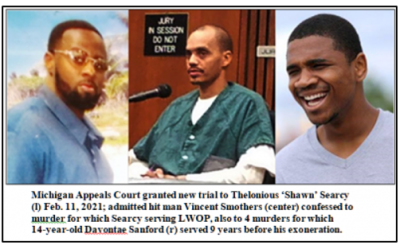
Worthy, Nessel continue prosecution of exonerees linked to Vincent Smothers, who courageously confessed in court to crimes in exonerees Sanford, Searcy cases
Nessel convicts Smothers of falsifying affidavit in Shannon Anderson case, says she will investigate others.
Nessel has never charged hundreds of lying, corrupt cops and prosecutors who have wrongfully convicted thousands in the MDOC over the decades.
Are Michigan’s Governor Gretchen Whitmer and Attorney General Dana Nessel, with Wayne County Prosecutor Kym Worthy, engaged in a campaign of terror against prisoners fighting deadly conditions and wrongful convictions by corrupt prosecutors and police?
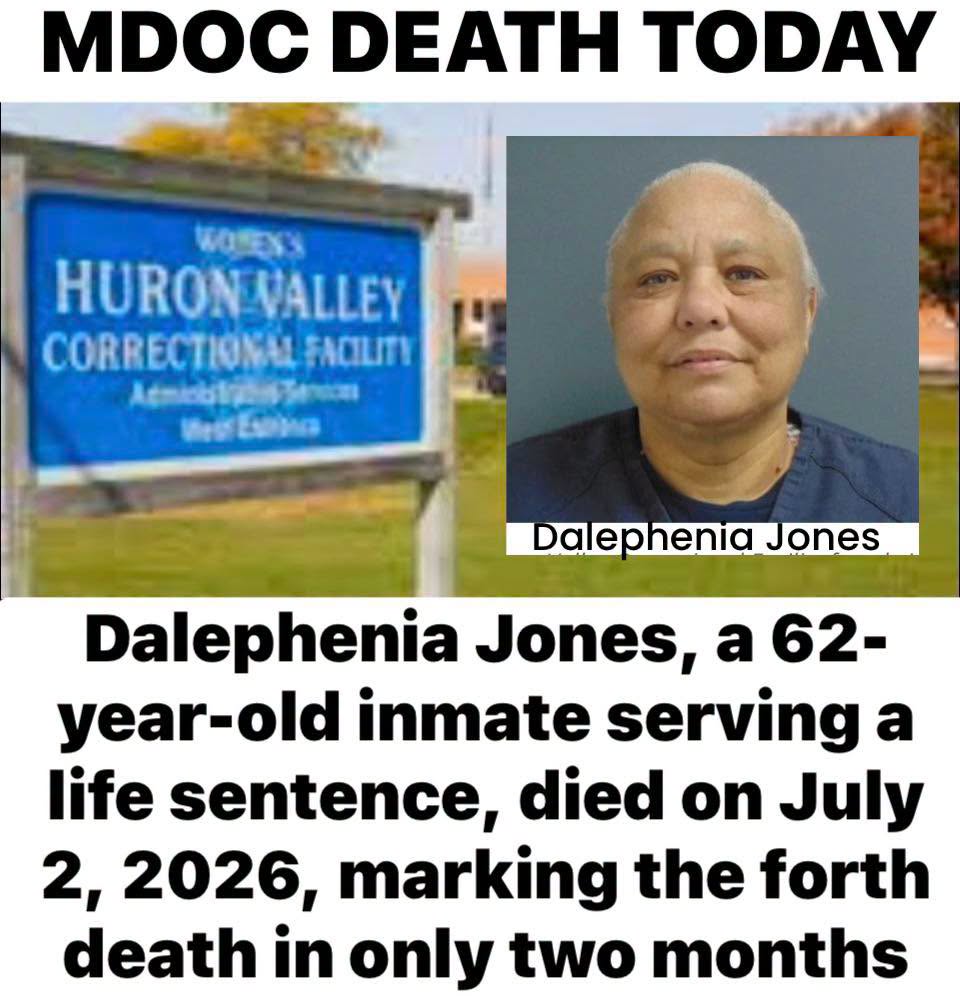
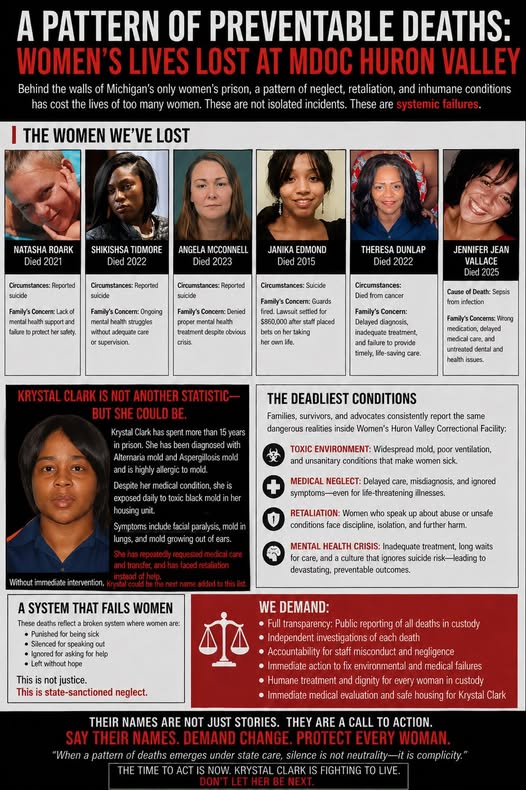
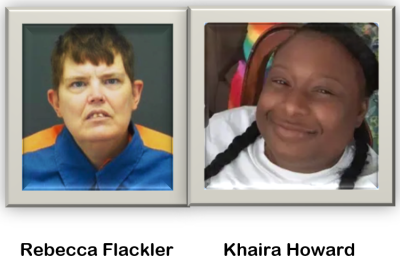
Khaira Howard and Rebecca Fackler died May 13 and May 17 at the Women’s Huron “Valley of Death” prison due to conditions including black mold and filthy ventilation systems, adding to a long list of deaths.
Heidi Washington, MDOC Director
Others like Krystal Clark are on the verge of death, but Michigan Governor Gretchen Whitmer has refused to commute her sentence to allow hospitalization at home. State legislators are now calling for the resignation of MDOC Director Heidi Washington after broad coverage of efforts by Jay Love of “Turning a Moment into a Movement and Trische Duckworth of “Survivors Speak.” But the horrendous situation at WHV should not have to wait on Washington’s desire to resign. She can be FIRED by Gov. Whitmer, who appointed her. AG Dana Nessel also plays a key role here.
WHV women are dying while Nessel stonewalls a federal lawsuit they filed in 2019. The prisoners won a historic ruling recognizing the horrific conditions and denying immunity to MDOC Director Heidi Washington and dozens of other WHV officials in 2025. Nessel appealed the denial of immunity to the Sixth Circuit, causing a delay in discovery that would lead to final orders for remediation.
Nessel’s attorneys argued, “There are no cases establishing a prisoner’s right to be free from these molds, . . . that it is not clearly established that any type of mold at WHV is sufficiently dangerous to incarcerated people, and even if it were clearly established that certain molds were dangerous enough to implicate the 8th Amendment it is not clearly established that prison officials need to take any particular action to remediate the presence of mold.”
AG DANA NESSEL, MDOC’S SHAWN BREWER TARGET VINCENT SMOTHERS, WHO AIDED DAVONTAE SANFORD, THELONIOUS SEARCY EXONERATIONS
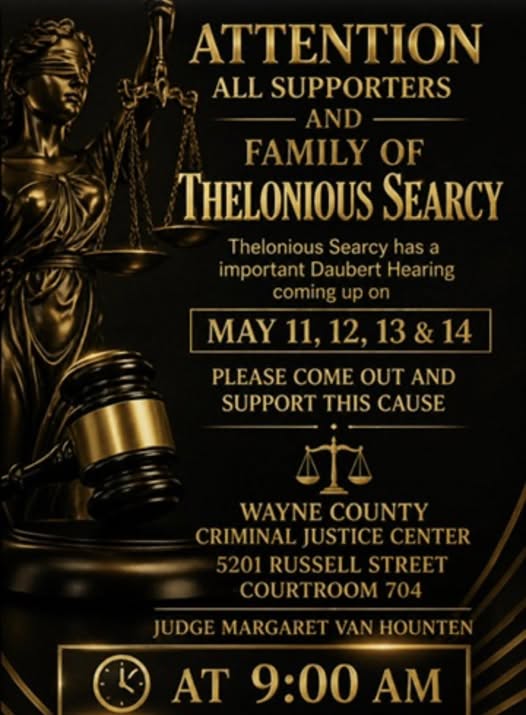
Note: VOD has been covering “Daubert” hearings currently being held in Thelonious Searcy’s case, where the defense is challenging the credentials of firearms and ballistics experts called by the prosecution. Such testimony has been frequently discredited as ‘junk science’ over the previous decade. A separate VOD story on those complex hearings is coming next. See: The Field of Firearms Forensics Is Flawed | Scientific American.
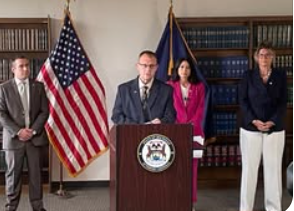
Last year, AG Dana Nessel charged Vincent Smothers and another prisoner, Shannon Anderson, with obstruction of justice for allegedly executing a false witness affidavit and possession of a contraband cell phone Aug. 28, 2025. They were later convicted.
Shannon Anderson
“Fabricating testimony or evidence in order to defraud the courts drives a stake into the heart of our criminal justice system,” Nessel said, as MDOC’s Asst. Dep. Director Shawn Brewer stood by her side. “Exposing such conduct and ensuring that false evidence is not submitted to or accepted by our courts is vital to the safety and wellbeing of Michigan residents.
Iin his ruling on the WHV lawsuit, USDC Judge Stephen Murphy cited Brewer for banning inmates from even talking about the black mold in the prison, due to fears of a riot. (Box left above.)
MDOC”s Asst. Dep. Dir. Shawn Brewer speaks at Dana Nessel press conference 8/28/2025
At the press conference announcing the charges, Nessel and Brewer said they continue to look at other cases to determine id Smothers took credit for crimes he didn’t commit or offered false information. She suggested money was the motivating factor for Smothers.
But neither Nessel nor Wayne Co. Pros. Kym Worthy have ever charged any of the lying, corrupt cops shown below, who have been featured in VOD stories on wrongful convictions. They are living their lives in the world outside the walls, making good salaries and pensions, raising their families, partying and playing sports, attending weddings and graduations, having a great time while their victims slowly die a little bit every day in prison.
DPD Det. Barbara Simon during deposition in 2022,
One of the officers shown below, DPD Inv. Barbara Simon, has been featured in a series in the Detroit Metro Times and picked up by CNN, citing cases of men exonerated after she elicited false confessions from them.
They include Mark Craighead, Lamarr Monson, Justly Johnson, Kendrick Scott, Eric Anderson, Roy Blackmon, and George Calicut Jr. The DMT says those cases have cost the City of Detroit $25 million by themselves to date. Their article states it is likely she framed a total of 30 individuals.
The DMT further notes that Simon has never been disciplined, charged or convicted despite her criminal past, and that she is now retired, living on two pensions from the city and the State of Michigan. Wayne Co. Prosecutor Kym Worthy’s Conviction Integrity Unit has freed six of the men, but eight others cited in the DMT article remain in prison while the CIU investigates.
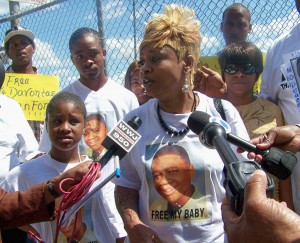
Mother Taminko Sanford leads family’s rally for Davontae June 29, 2010/VOD Photo by Diane Bukowski
DPD Officers Michael Russell, James Tolbert, and Dale Collins, also shown below, have never been disciplined, charged or convicted for the crimes they committed in the frame-up of Davontae Sanford. But the City of Detroit awarded $7.5 million to Sanford to settle a lawsuit brought by Sanford, which gives horrific details of the deliberate frame-up job they did on a 14-year-old child for the murders of four people in an alleged drug house.
Sanford spent the next nine years in adult prisons, where he was subjected to gross mistreatment by prison guards on an ongoing basis. A year after Sanford was convicted, Vincent Smothers told DPD detectives Gerald WIlliams and Ira Todd that he and an accomplice, Ernest Davis, committed the crimes involved. They told him to stay quiet on the matter, but he courageously came forward to absolve Sanford, in another confession with accurate details about the crime.
Kym Worthy cited as “Innocence Denier’ in the case of Davontae Sanford, Slate Magazine
The civil lawsuit in Sanford’s case details the crimes of the DPD officers, as well as the unremitting involvement of the Wayne Co. Prosecutor Kym Worthy, who still refuses to recognize Sanford’s innocence.
The mainstream media across the U.S. and even the globe have jumped onto the bandwagon on the Smothers/Anderson charges in full force, featuring contemptuous stories like the Detroit News article by George Hunter, headlined, “Detroit ‘Hitman for Hire’ Becomes Convicted Liar-for-Hire.”
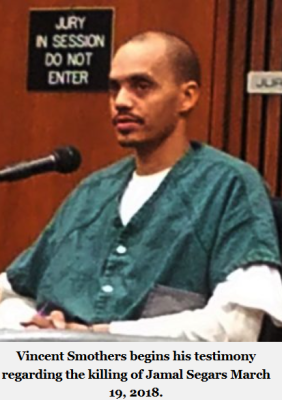
These charges were clearly brought to target Thelonious Searcy, who is being re-tried a second time despite days of detailed testimony in court by Vincent Smothers confessing to the murder involved in his case during a 2018 evidentiary hearing. But the charges involve only an alleged false affidavit. They cannot eclipse or wipe out Smothers’ three days of detailed testimony in court in 2018.
VOD covered every day of that evidentiary hearing. We were highly impressed by Smothers’ courageous testimony. He never took the stand in the Davontae Sanford case, He submitted his confession to the murders of four men in an alleged drug house that Detroit cops had pinned on a 14-year-old child through his attorney, who would not let him testify.
That testimony, along with falsified ballistics reports, caused a Michigan Court of Appeals panel to overturn Searcy’s conviction Feb. 11, 2021, accusing trial judge Timothy Kenny of an abuse of judicial discretion for (See box at left.)
They resulted in a resounding ruling from 3rd CC Judge Thomas Hathaway dismissing the charges WITH PREJUDICE in 2022.
Hathaway cited the prosecution’s ongoing refusals to produce exculpatory evidence, indicating that he did not expect Searcy to EVER get a fair trial by this Prosecutor’s Office.
Now Searcy is being re-tried a second time, in front of the highly conservative WCC Judge Margaret Van Houten, previously a Dearborn Heights politician and currently active with the East Side Republican Club.
Smothers was previously set to testify during that re-trial, but it was delayed after the Michigan Supreme Court ordered Van Houten to conduct a “Daubert” hearing examining the credentials of State of Michigan firearms and ballistics experts the prosecution wants to bring forward. The MSC overruled her refusal to hold the hearing, saying that it was an abuse of HER discretion.
Detroit Free Press reporter Tresa Baldas earlier interviewed Searcy’s attorney Michael Dezsi, who said, “While the prosecutors have always made clear they don’t believe Smothers, they have never produced any evidence whatsoever to support their claim that Smothers’ confession was false or paid for. If they have evidence that Smothers’ confession is false, or paid for, they have yet to produce such evidence to me or to the court.” See VOD’s interview with Dezsi after Smothers’ testimony 3/19/18, and private investigator Scott Lewis’ interview with Smothers, below.
URGENT. Funds needed for quarterly web hosting charge of $465 due June 19, 2026. VOD, a pro bono newspaper, now devotes itself entirely to stories about our PRISON NATION and POLICE STATE. If fee is not paid, VOD and 14 years of stories will disappear from the web.
VOD’s editors and reporters, most of whom live on fixed incomes or are incarcerated, are not paid for their work. In addition to quarterly web hosting charge. other expenses include P.O. box fee of $226.00/yr., costs including utility and internet bills, costs for research including court records and internet fees, office supplies, gas, etc.
PROTEST AT WOMEN’S HURON VALLEY CORRECTIONAL FACILITY FOLLOWING MULTIPLE DEATHS AND WORSENING MEDICAL CRISIS
Dana Nessel and Gretchen Whitmer
We are absolutely horrified that the women who lead our state, Gov. Gretchen Whitmer and AG Dana Nessel have for years now ignored the plight of our sisters at Women’s Huron Valley, as well as thousands of others inside MDOC. Nessel never kept her campaign promise to juvenile lifers. Whitmer refused to release prisoners dying from COVID-19. JAIL THE REAL CRIMINALS IN WHV NOW! Diane Bukowsk, editor, Voice of Detroit.
Story below by Trische Duckworth Survivors Speak
May 20, 2026
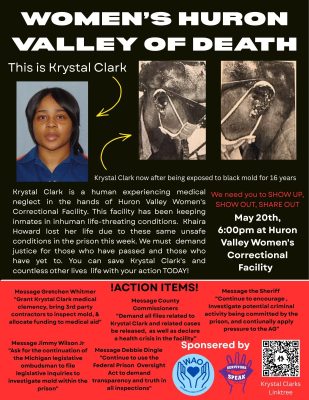
YPSILANTI, MI — Community members, advocates, formerly incarcerated women, faith leaders, and concerned residents gathered May 20 outside of Women’s Huron Valley Correctional Facility (3201 Bemis Rd., Ypsilanti, MI) to demand immediate intervention regarding what organizers describe as dangerous and life-threatening conditions inside the prison.
The protest comes amid growing outrage following the deaths of Khairi Howard and Rebecca Fackler this week, as well as the worsening medical condition of incarcerated woman Krystal Clark, whose supporters say has suffered years of exposure to black mold and severe medical neglect while housed inside the facility.
Organizers state that the demonstration is intended to bring public attention to ongoing reports of unsafe living conditions, lack of adequate medical care, environmental hazards, and alleged systemic neglect impacting women incarcerated at Women’s Huron Valley Correctional Facility.
“This is not just about one person, it never has been, as Krystal has sounded the alarm for everyone, all while her own condition is worsening,” said Trische Duckworth, Founder and Executive Director of Survivors Speak. “Women are suffering. Families are grieving. We are calling on elected officials, oversight bodies, and the broader community to stop ignoring what is happening behind those walls.”
“We at Workers Against Oppression are heartbroken and disgusted by the abhorrent conditions at the Huron Valley Women’s Correctional Facility,” said Zane Parker of WAO. “This protest is being held to demand that our representatives listen to their constituents and do everything in their power to urge Gretchen Whitmer to grant medical clemency to Krystal Clark. We are also demanding that the grotesque conditions faced by the people in the facility be fully investigated and corrected, and that any person complicit in the facility’s criminal conditions be held accountable to the fullest extent of the law.”
According to advocates, Krystal Clark’s health has continued to decline, and supporters are urgently calling for:
Immediate medical clemency for Krystal Clark
Independent third-party inspections for mold and environmental hazards
Transparency surrounding deaths, medical emergencies within the facility
Legislative and federal oversight investigations
Emergency action to protect women currently housed at WHV
The protest flyer also encourages community members to contact state and local officials demanding accountability and immediate intervention.
SURVIVORS SPEAK AND WORKERS AGAINST OPPRESSION CALL ON MEDIA TO PUSH BEYOND POLITICAL NARRATIVES AND DEMAND TRUTH
YPSILANTI, MI — As legislators now publicly call for the resignation of Michigan Department of Corrections Director Heidi Washington, Survivors Speak is urging journalists and news outlets not to allow years of warnings, evidence, and survivor testimony to be erased or politically repackaged.
For more than four and a half years, those housed inside WHV, Survivors Speak, impacted families, formerly incarcerated women, advocates, and community members have consistently sounded the alarm about the dangerous and unconstitutional conditions inside Women’s Huron Valley Correctional Facility (WHV).
Today, as public pressure mounts and political leaders begin to distance themselves from the crisis, Survivors Speak is calling on the media to push deeper, ask harder questions, and center the facts that have long been available.
“We cannot allow this moment to become political theater while women continue to suffer behind those walls,” said Trische Duckworth, Executive Director/Founder of Survivors Speak. “The evidence has existed. The testimonies have existed. The warnings have existed. Women have been crying out for help for years.”
Survivors Speak is specifically asking journalists to continue investigating and publicly examining the following:
The State’s own Building Report documenting horrid and hazardous conditions inside Women’s Huron Valley Correctional Facility.
Federal court findings in which a judge cited harmful and unconstitutional conditions impacting women housed at the prison.
Medical records connected to incarcerated advocate Krystal Clark reportedly documenting exposure to mold, including Aspergillus.
Recent medical visit notes showing Krystal Clark’s continued physical decline, including worsening conditions involving her ears and overall health.
Advocates are also urging members of the media, if granted access inside the facility, to request to see and speak with Krystal Clark directly and to ask questions about the ongoing conditions women are enduring daily.
Trische Duckworth, Jay Love
“This is bigger than one resignation,” said Jay Love, host of Turning A Moment Into A Movement/President of Survivors Speak. “Women have suffered. Women have died. Families have begged for intervention. If accountability is finally being discussed publicly, then the full truth must also be discussed publicly.”
Advocates believe that journalists have the power to elevate the voices of incarcerated women and expose conditions that many believe have been ignored for far too long.
“We are asking media outlets to use their platforms courageously,” said Duckworth. “Your reporting could help save lives. Your questions could force transparency. Your coverage could become the conduit to freedom, accountability, and protection for many women still trapped in these conditions.”
Survivors Speak and Workers Against Oppression continue to call for transparency, independent oversight, accountability, and immediate intervention regarding conditions at Women’s Huron Valley Correctional Facility.
For interviews, testimony, supporting documentation, or additional information, please contact: Trische Duckworth
Executive Director, Survivors Speak
(734) 834-4736 www.survivorsspeak.info
URGENT. Funds needed for quarterly web hosting charge of $465. VOD, a pro bono newspaper, now devotes itself entirely to stories about our PRISON NATION and POLICE STATE.
VOD’s editors and reporters, most of whom live on fixed incomes or are incarcerated, are not paid for their work. In addition to quarterly web hosting charge. other expenses include P.O. box fee of $226.00/yr., costs including utility and internet bills, costs for research including court records and internet fees, office supplies, gas, etc.
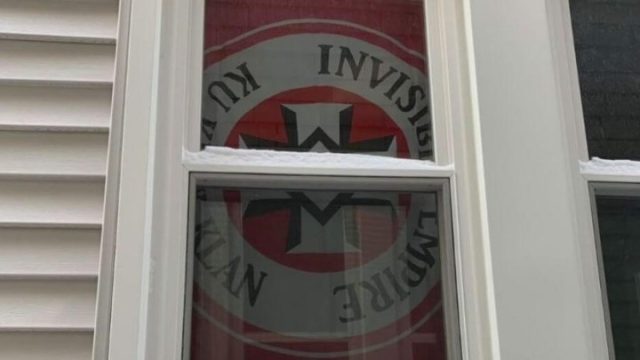
Wayne County Prosecutor Kym Worthy refused to file hate crime charges against a Grosse Pointe resident flying the KKK flag (above) next door to his Black neighbors, who have now won a federal lawsuit against the man.
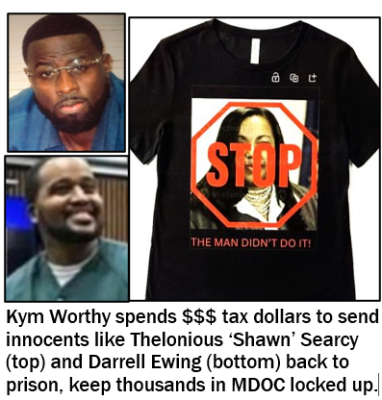
Meanwhile, Worthy’s office is spending millions in taxpayer dollars trying to return exonerated Detroiters Thelonious ‘Shawn’ Searcy and Darrell ‘Apple’ Ewing to prison for life, despite clear proof of their innocence upheld by higher courts. Other wrongly incarcerated MDOC prisoners like Kevin Sykes and Steven Williams, along with an estimated 30% of the MDOC population, continue to fight for freedom against deeply corrupt police and prosecutors across Michigan.
A settlement has been reached in a federal lawsuit filed by a Black Grosse Pointe Park resident against her former neighbor, who was accused in February 2021 of racial intimidation for hanging a Ku Klux Klan flag in his window that faced Je Donna and India Dinges’ home.
The settlement agreement and the monetary award associated with the settlement in Dinges v. Wilde has not been disclosed. Still, the Dinges family viewed the settlement as a major civil rights win and yet another hedge against ethnic and racial intimidation in Michigan.
“We felt terrorized. We feared for our lives,” said Je Donna Dinges. “In the face of hatred and bigotry, we should all stand up, speak up, and fight back. This case was our way of doing that.”
Dinges and her daughter India claimed they were the victim of racial intimidation when they identified a Ku Klux Klan flag hanging in the window of their neighbor Ryan Wilde’s home. The window faced the Dinges’ dining room. India Dinges was a college student at the time, and said in a statement that it interfered with her daily life.
“During Covid, when the public was advised to stay inside, I could not find comfort in my own home,” India Dinges said.
Grosse Pointe Park’s Department of Public Safety responded by sending detectives to visit Dinges’ neighbor, who was told to remove the flag.
The Dinges family filed a racial harassment and discrimination lawsuit in the U.S. District Court for the Eastern District of Michigan.
The lawsuit came after Wayne County Prosecutor Kym Worthy declined to bring charges against Wilde, saying the flying of the flag was abhorrent but did not rise to the level of a criminal act of intimidation.
The incident with the flag spurred a march in support of her and her daughter India as they sought a civil remedy against Wilde. The incident also led Dinges to co-found the Ethnic Intimidation Law Amendment Work Group, which advocated for stronger hate crime and ethnic intimidation laws beginning in 2021.
JeDonna Matthews Dinge with members of the task force she founded.
The work group was an early leader of the effort later picked up by state Rep. Noah Arbit (D-West Bloomfield) to enhance the state’s hate crime laws. That effort culminated in victory when Gov. Gretchen Whitmer in 2024 signed the Michigan Hate Crime Act into law.
The act overhauled the state’s 1988 Ethnic Intimidation Act with new penalties with stronger teeth to protect against racial discrimination, violence and the type of harassment the Dinges family endured from Wilde.
Ku’Juana Quinn
Aside from the new law becoming effective in 2025, a challenge to the Dinges family lawsuit from Wilde attempted to prevent the lawsuit from moving forward. The motion to dismiss the civil case was ultimately denied by U.S. District Judge Linda Parker of the Eastern District of Michigan.
The Civil Rights Litigation Initiative at the University of Michigan Law School represented the Dinges family in this lawsuit.
“Je Donna and India Dinges are true heroes,” said CRLI Student Attorney Ku’Juana Quinn in a statement. “They bravely stepped forward and fought for justice not just for themselves but for everyone in Michigan.”
‘INNOCENCE DENIER’ WAYNE CO. PROS. KYM WORTHY CONTINUES BOGUS APPEALS OF THELONIOUS SEARCY’S 2022 EXONERATION
By Diane Bukowski
May 10, 2026
We are asking all justice lovers to support Thelonious ‘Shawn’ Searcy this week in court as he battles for permanent freedom after Wayne County Circuit Court Judge Thomas Hathaway dismissed all charges against him WITH PREJUDICE October 3, 2022. Among other issues, Judge Hathaway cited the prosecution’s deliberate suppression of the actual caliber of a bullet taken from the victim’s body, not consistent with the gun alleged to be the murder weapon.
Judge T. Hathaway/Thelonious Searcy
“This Court concludes that the damage caused by the suppression and withholding of the exculpatory evidence cannot be cured,” Hathaway ruled. “Therefore, it holds that dismissal of the charges is appropriate given the severe and deliberate violations of the defendant’s due process rights that denied him a fair and impartial trial. Accordingly, this Court GRANTS defendant’s Motion to Dismiss.”
A Court of Appeals panel overturned Hathaway, saying he had “abused his discretion” as a trial judge by ordering the permanent dismissal of charges, a ruling termed dubious by legal experts.
Judge Margaret Van Houten
Wayne 3rd Circuit Court Judge Margaret van Houten is now handling pre-trial hearings on the original murder charges against Searcy. On Nov. 19, 2025, the Michigan Supreme Court ordered Judge van Houten to hold “Daubert” hearings set for May 11, 12, 13 and 14, saying she had abused HER discretion by “failing to act as a gatekeeper of expert opinion testimony.”
“In lieu of granting leave to appeal, we VACATE the May 23, 2025 order of the Wayne Circuit Court denying the defendant’s motion to exclude expert testimony on ballistics and toolmark identification. The trial court abused its discretion by failing to act as a gatekeeper of expert opinion testimony under MRE 702. Gilbert v DaimlerChrysler Corp, 470 Mich 749, 782 (2004). We REMAND this case to that court to conduct an evidentiary hearing to consider whether the plaintiff’s proposed expert testimony meets the criteria of MRE 702.”
Michael Jackson-Bolanos
Judge Van Houten earlier sentenced Michael Jackson-Bolanos to a term of eight months to 15 years for “lying to police” after a jury acquitted him of murder and home invasion charges in the 2023 death of Detroit Synagogue leader Samatha Woll, despite the Department of Corrections recommending an 18-month probation.
The case became a cause celebre among many in the Black community who viewed it as an example of an impoverished Black man railroaded for the death of a well-to-do white woman. Judge Van Houtens’ stunningly biased remarks at Bolanos-Jackson’s sentencing can be heard below. Jackson-Bolanos is still in prison.
URGENT. Funds needed for quarterly web hosting charge of $465. VOD, a pro bono newspaper, now devotes itself entirely to stories about our PRISON NATION and POLICE STATE.
VOD’s editors and reporters, most of whom live on fixed incomes or are incarcerated, are not paid for their work. In addition to quarterly web hosting charge. other expenses include P.O. box fee of $226.00/yr., costs including utility and internet bills, costs for research including court records and internet fees, office supplies, gas, etc.
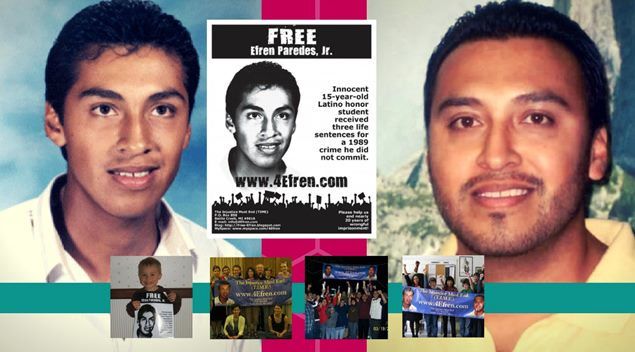
VOD EDITOR DIANE BUKOWSKI: Efren Paredes was 15 when he was given three life sentences for a murder in Benton Harbor, MI that he did not commit. The racist and criminal injustice system there and in Berrien County repeatedly denied his requests for re-sentencing as a juvenile lifer pursuant to U.S. Supreme Court rulings in Miller v. Alabama (2012) and Montgomery v. Louisiana (2016). VOD has covered Efren’s story since 2010, carrying on coverage by the MICHIGAN CITIZEN previously. BE SURE TO HIT THE LINK TO SIGN AMNESTY INTERNATIONAL’S DIGITAL PETITION TO GOV. WHITMER:
Rally at Michigan State Capitol against life without parole not only for juvenile lifers, but for all prisoners.
Many people in communities of color and other marginalized neighborhoods see the story of Efrén Paredes Jr. (MDOC #203116) as something bigger than one person. It speaks to the struggles so many families know — growing up in places where opportunity is limited, where bias shapes outcomes, and where young people are often punished more harshly than they deserve.
Children of color make up approximately 34% of Michigan’s children, but comprise 82% of people initially sentenced to die in prison over the last 13 years. This makes life-without-parole sentences a clearly unconstitutional racialized punishment policy when applied to children. (Children’s Defense Fund, “The State of America’s Children in Michigan: 2023 Factsheet” (2023)).
Those who have followed Efrén’s nearly four-decade-long journey behind bars since age 15, have witnessed his enormous growth, reflection, and tireless commitment to lifting others up through education and advocacy. People who support him say that mercy isn’t just a legal idea — it’s a moral one. They point out that justice should include redemption, healing, and the chance to rebuild a life. Supporters often share that Efrén’s transformation reflects the kind of hope our communities fight for every day: the belief that no one is beyond change, and no one should be defined forever by their worst moment.
Illustration from In These Times article on Efren Paredes Jr.
Today, Efrén is a college student in his junior year attending Western Michigan University’s Higher Education for the Justice-Involved (HEJI) program, where he is pursuing a Bachelor of Liberal Arts degree and majoring in Interdisciplinary Studies.
He is also a journalist and social justice changemaker who works to support racial justice, conflict resolution, and empower members of marginalized communities. A list of Efrén’s impressive accomplishments during his incarceration can be accessed at: https://EfrensWords.home.blog/Efrens-Accomplishments.
Many community members across Michigan are calling on the Honorable Governor Gretchen Whitmer to consider what granting Efrén a commutation of his 1989 sentence would mean. They see it as an act of courage, compassion, and leadership that honors the dignity of every human being. They believe it would send a message that Michigan values fairness, second chances, and the voices of the people who are too often unheard. This would promote a more equitable and humane criminal legal system.
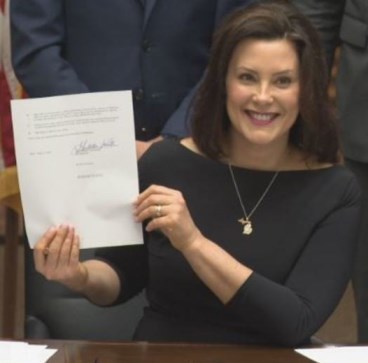
Gov. Whitmer signs law creating a commission on criminal justice reform in April, 2019.
According to a 2020 report by the Urban Institute (How Governors Can Use Categorical Clemency as a Corrective Tool) eighty percent of voters polled support using executive clemency to achieve reductions in prison populations. I add my voice to the 80% of individuals who support Governor Whitmer’s use of clemency and urge her to bestow mercy upon Efrén by granting his request for commutation of sentence.
It is my fervent prayer that the Governor will allow Efrén the opportunity to one day become a productive member of society. Without a granting of clemency, he could die in prison never once having experienced freedom during his adult life.
Thank you for your time and thoughtful consideration.
URGENT. Funds needed for quarterly web hosting charge of $465. VOD, a pro bono newspaper, now devotes itself entirely to stories about our PRISON NATION and POLICE STATE.
VOD’s editors and reporters, most of whom live on fixed incomes or are incarcerated, are not paid for their work. In addition to quarterly web hosting charge. other expenses include P.O. box fee of $226.00/yr., costs including utility and internet bills, costs for research including court records and internet fees, office supplies, gas, etc.


 In 1992, Carl’s life changed forever when he was framed for murder. A person named Rodnell Penn was shot and killed in the middle of the night in the neighborhood of Detroit in which Carl was living. The trail in Penn’s case soon went cold. The police found no eyewitnesses to the shooting, no blood samples or DNA evidence point to a suspect, and no murder weapon. But as has been revealed through an investigation by the U.S. Department of Justice, it was a “lawless time for Detroit’s homicide division.” Detectives regularly coerced false confessions in order to close cases.
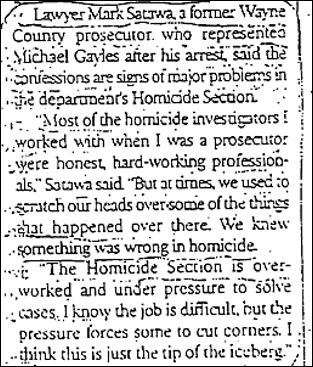 One notorious detective named Joann Kinney—the lead investigator in Penn’s case—was no different. In a different case, Kinney had admitted to having someone “locked up as a witness for days without charges” and “threatening to take [the person’s] children away if she did not cooperate.” In another case, Kinney charged someone with murder “without a ‘scintilla of evidence.’”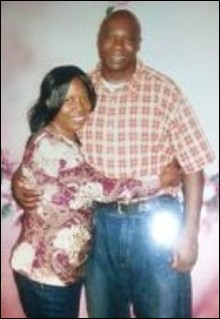


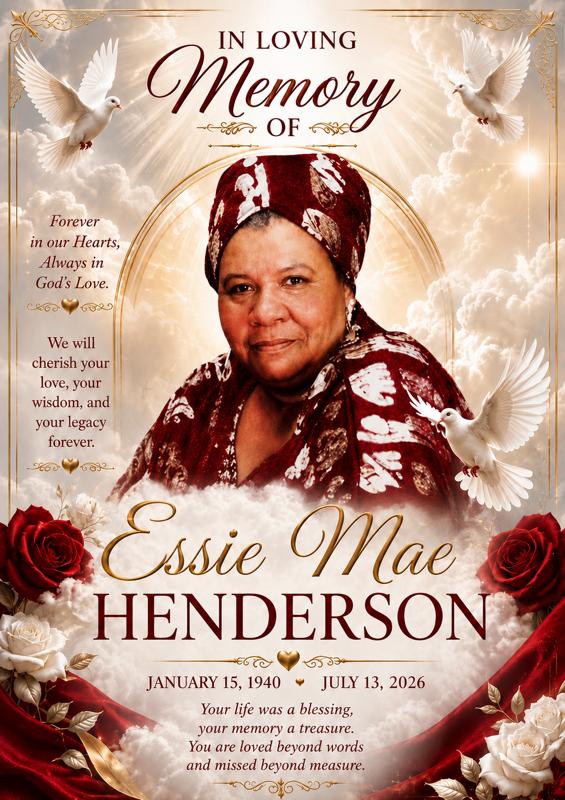
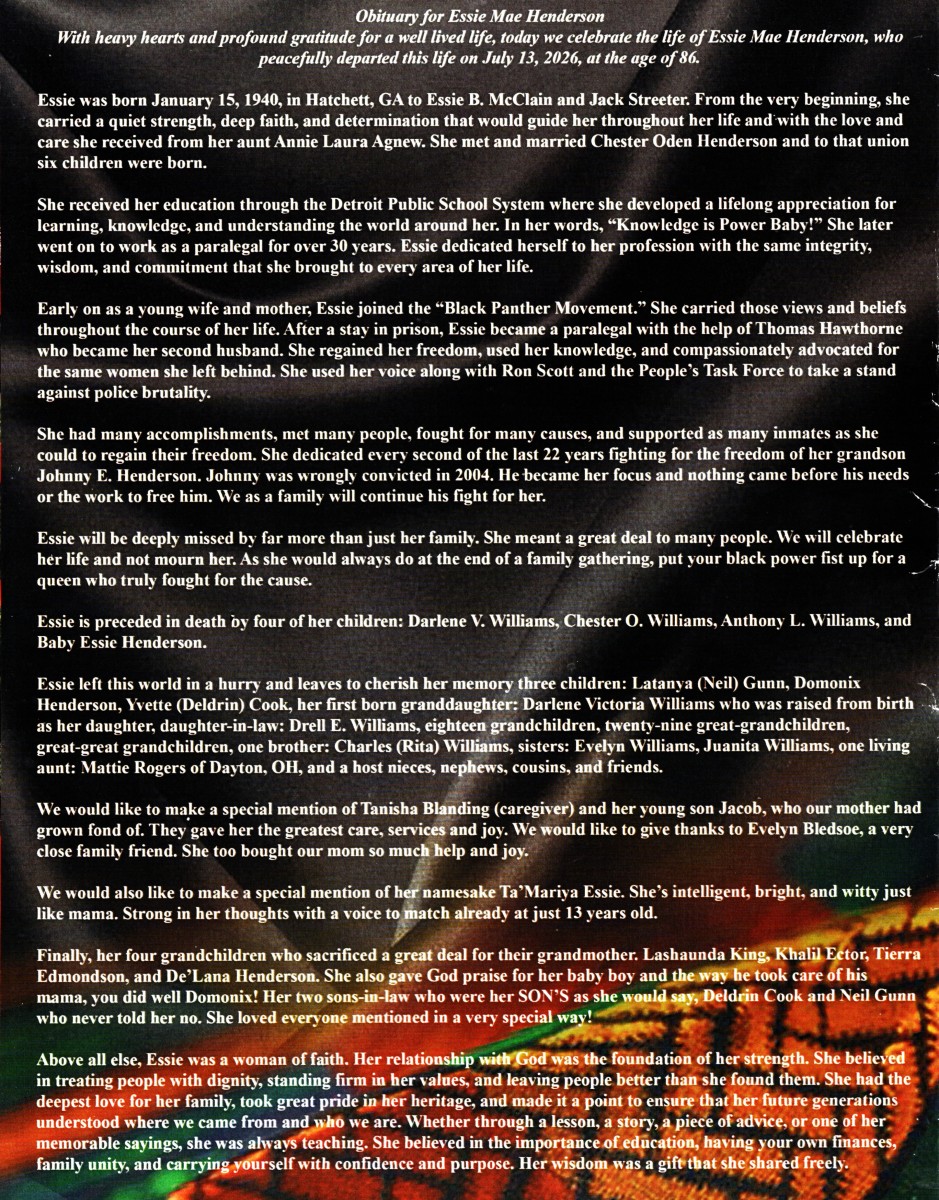
 UPDATE: VOD Editor Diane Bukowski attended the memorial for Essie Mae Henderson. It was awe-inspiring. The chapel was filled with her descendants of all ages, including young people who had been politically educated by Essie, and spoke of her with deep love and respect, calling her GranGran. Her daughter and granddaughter spoke with great passion about her life. The memorial concluded with the entire audience raising their fists and chanting “POWER.” Above is the detailed story of her inspiring life in the obituary. _______________________________________________________
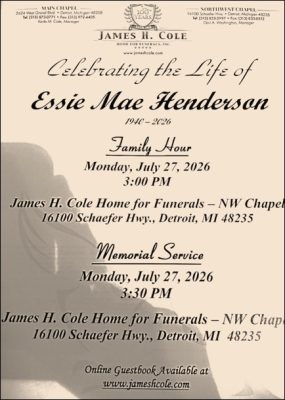 Essie Mae Henderson lived heroic life:


 URGENT. Funds needed for quarterly web hosting charge of $465 due Sept. 19, 2026. VOD, a pro bono newspaper, now devotes itself entirely to stories about our PRISON NATION and POLICE STATE. If fee is not paid, VOD and 14 years of stories will disappear from the web.
 DETROIT, Mich. (July 14, 2026) — Advocates for incarcerated Michigan woman Krystal Denise Clark are calling for her immediate hospitalization and medical release, saying her health has deteriorated to a critical level while she remains in the custody of the Michigan Department of Corrections (MDOC).
 Outside infectious disease specialists have repeatedly warned that Clark cannot recover while remaining in a mold-contaminated environment. One specialist recommended six to twelve months of advanced antifungal therapy with close laboratory monitoring and stated that she should be permanently removed from mold exposure. Other treating physicians documented concern that the fungal infection could become invasive, while occupational medicine specialists confirmed her significant allergy to mold and advised that she should avoid any future mold exposure.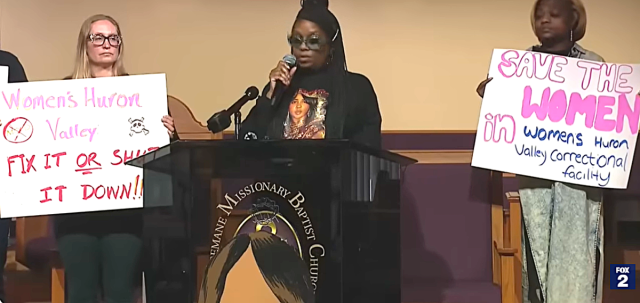
 Clark’s case has drawn increasing attention from lawmakers, medical professionals, faith leaders, formerly incarcerated advocates, and human rights organizations amid broader concerns about reported medical neglect and environmental conditions within Michigan’s prison system.


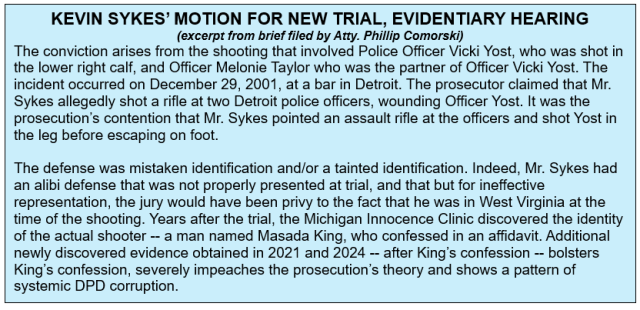
 WCCC Judge Patricia Fresard, Sykes’ trial judge in 2002, once again denied Sykes’ motion for a new trial and an evidentiary hearing April 7, 2026, refusing to hear directly from witnesses.
 Fresard has now denied Sykes an evidentiary hearing in which she would have heard Masada King, the actual shooter, testify to assess his credibility, acting as a “reasonable juror,”
 Tyrone DeShawn Moore said that DPD Inv. Barbara Simon falsified his statement and forged his signature (see box left).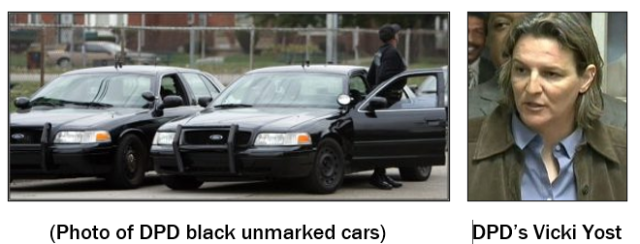


 After retiring from decades in the Detroit and Inkster Police Departments, Vicki Yost founded Shield Strategic Solutions, a private investigation agency.

 The Detroit Police Department rewarded Vicki Yost with promotion after promotion after Grable’s death. Only five years afterwards, when she was shot, Yost had made lieutenant and rapidly ascended the ranks to become a Deputy Police Chief.
 From her years in the Detroit Police Department ascending to Deputy Chief, Yost would have known that Melendez and 17 other 3rd and 4th Precinct cops were charged by the U.S. Department of Justice in 2004 with running a “Ramparts” style squad that was wreaking havoc in Detroit’s Black community, framing up defendants they arrested and torturing and beating them, including hanging them out windows and other atrocities.
 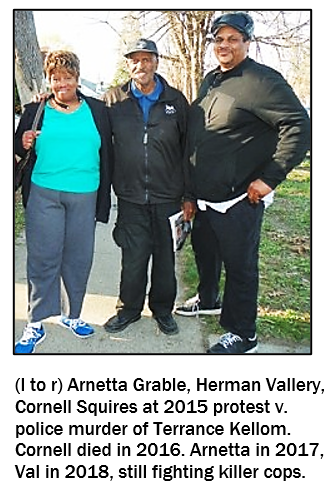 The toll such cases take on the lives of the families and their supporters is enormous. Cornell Squires died in 2016, Arnetta Grable in 2017, and Herman Valley in 2018. Cornell Emmanuel Squires, Cornell’s son who had two young children when his dad died, died at the age of 41 in 2023. Their souls are still calling out for justice for Lamar Grable and other victims of police and mass incarceration.

 UPDATE Aug. 6: Ashley Diane Hough, =dI sWomen at Huron Valley die while Nessel stonewalls federal lawsuit after judge denied damage immunity to Director Heidi Washington, Shawn Brewer, other MDOC officials

 WHV women are dying while Nessel stonewalls a federal lawsuit they filed in 2019. The prisoners won a historic ruling recognizing the horrific conditions and denying immunity to MDOC Director Heidi Washington and dozens of other WHV officials in 2025. Nessel appealed the denial of immunity to the Sixth Circuit, causing a delay in discovery that would lead to final orders for remediation.
 AG DANA NESSEL, MDOC’S SHAWN BREWER TARGET VINCENT SMOTHERS, WHO AIDED DAVONTAE SANFORD, THELONIOUS SEARCY EXONERATIONS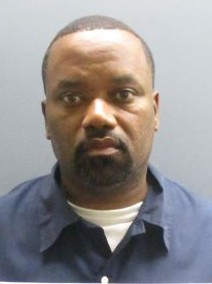

 These charges were clearly brought to target Thelonious Searcy, who is being re-tried a second time despite days of detailed testimony in court by Vincent Smothers confessing to the murder involved in his case during a 2018 evidentiary hearing. But the charges involve only an alleged false affidavit. They cannot eclipse or wipe out Smothers’ three days of detailed testimony in court in 2018.
 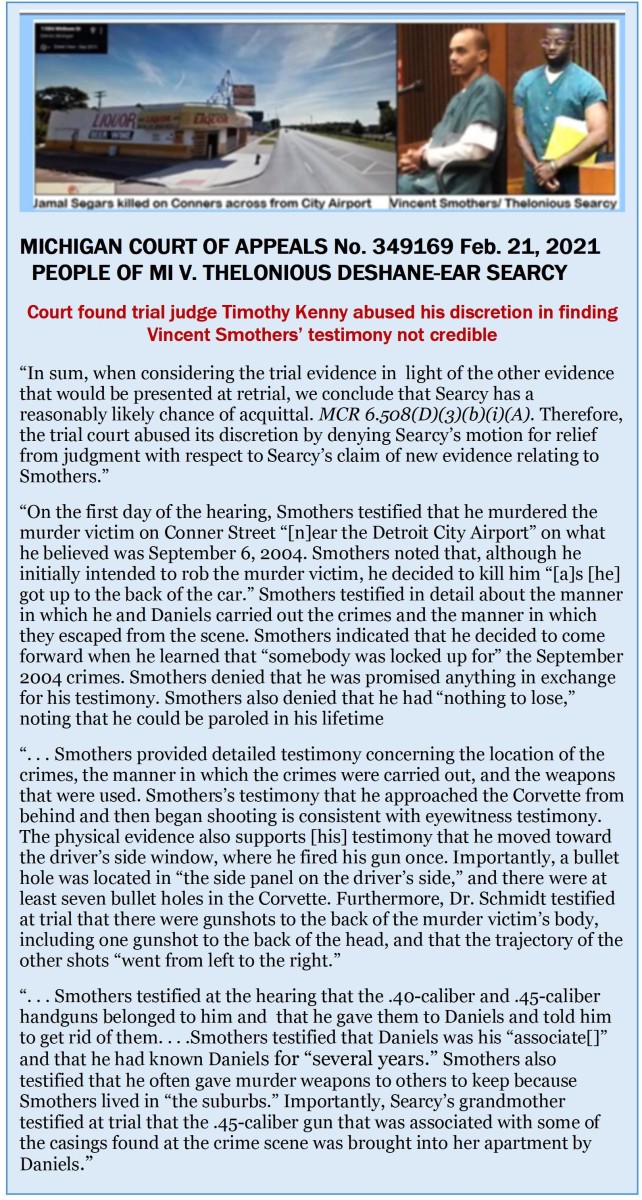 That testimony, along with falsified ballistics reports, caused a Michigan Court of Appeals panel to overturn Searcy’s conviction Feb. 11, 2021, accusing trial judge Timothy Kenny of an abuse of judicial discretion for (See box at left.)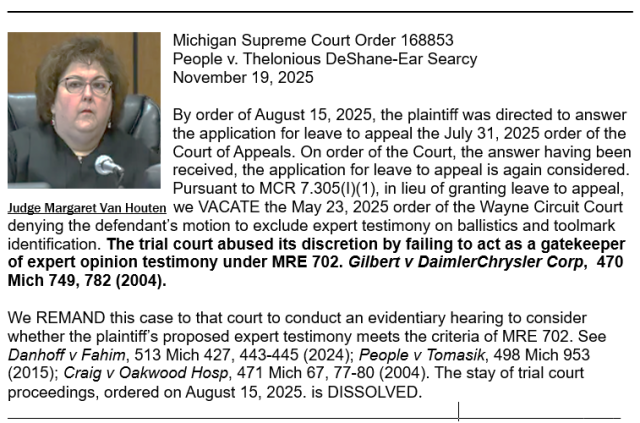

 YPSILANTI, MI — Community members, advocates, formerly incarcerated women, faith leaders, and concerned residents gathered May 20 outside of Women’s Huron Valley Correctional Facility (3201 Bemis Rd., Ypsilanti, MI) to demand immediate intervention regarding what organizers describe as dangerous and life-threatening conditions inside the prison.
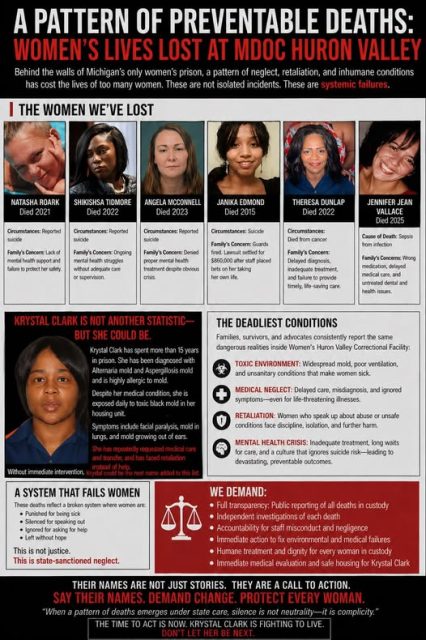 Organizers state that the demonstration is intended to bring public attention to ongoing reports of unsafe living conditions, lack of adequate medical care, environmental hazards, and alleged systemic neglect impacting women incarcerated at Women’s Huron Valley Correctional Facility.
 “We cannot allow this moment to become political theater while women continue to suffer behind those walls,” said Trische Duckworth, Executive Director/Founder of Survivors Speak. “The evidence has existed. The testimonies have existed. The warnings have existed. Women have been crying out for help for years.”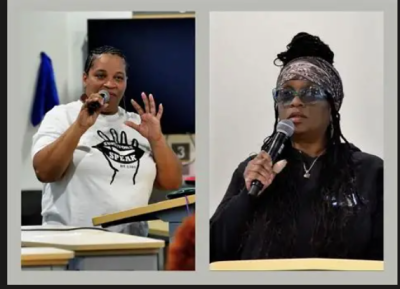
 Note from VOD Editor Diane Bukowski



 SUPPORT EFREN PAREDES JR.’S REQUEST FOR COMMUTATION! hit link: